
Fruit & Vegetable Packaging: A Decision Comparison for Fresh Produce Buyers
Fruit & Vegetable Packaging: Comparing PET Containers, Anti-Fog Options, Sealing and Drop Performance
At the decision stage, fruit and vegetable packaging selection changes from asking what is available to asking which container will protect produce, remain clear in a cold display, reduce repacking, and meet food-contact requirements after filling and distribution. A slightly higher unit cost often becomes acceptable when the alternative is cracked trays, fogged lids, leaking juice, or rejected lots. This article compares PET and PP fresh produce containers for fruit, salad, berries, tomatoes, and ready-to-eat formats, focusing on the decision criteria that affect total cost: sealing performance, anti-fog clarity, drop resistance, temperature tolerance, and tamper evidence.
Problem: similar-looking clamshells can carry very different risks
Buyers comparing fruit & vegetable packaging often see similar transparent produce packaging, farm market fresh food trays, and clear clamshell containers. The important differences are not always visible in a static product photo. They include wall thickness, sealing edge uniformity, anti-fog treatment, material grade, and closure geometry. If these factors are ignored, the result can be cracked containers after a 1.2m drop, fogged lids in cold-chain display, berry or salad liquids leaking in transit, or documentation gaps for EU food contact certified fresh food packaging.
In a Decision-stage review, the comparison should move from supplier price lists to failure costs. That means scoring containers on measurable issues like breakage, spoilage, repacking, and shelf appeal rather than on the base price alone.
Industry context for fresh produce packaging decisions
Fresh food packaging is a large and changing market. According to Spherical Insights & Consulting, the global fresh food packaging market reached USD 134.60 billion in 2024 and is projected to reach USD 240.50 billion by 2035. Market Research Future estimates the specific produce packaging market at approximately USD 38.08 billion in 2024. In Europe, the fresh food packaging market was valued at USD 15.2 billion in 2024, with a projected CAGR of 4.5% through 2033. Grand View Research expects the global thermoformed plastic market for food packaging to reach USD 20.66 billion by 2030, growing at a CAGR of 4.9%.
Regulatory pressure is increasing. EU Regulation (EC) No 1935/2004 provides the framework for all food contact materials, while Regulation (EU) No 10/2011 specifically governs plastic materials and articles intended to come into contact with food, including PET and PP containers. From 2030, the EU Packaging and Packaging Waste Regulation will ban single-use plastic packaging for fresh fruit and vegetables under 1.5kg. This does not eliminate plastic packaging immediately in every case, but it makes material choice, recyclability, and reuse scenarios more important for exporters and EU retail suppliers.
Global produce packaging suppliers include Amcor PLC, Berry Global Group, Sealed Air Corp, Mondi Group, and Smurfit Kappa. For a buyer, the practical question is not only who is the largest supplier, but whether a manufacturer can provide the specific PET fresh produce containers, food-contact documentation, and repeatable production control for the target market.
What CHUAN HE offers in fruit and vegetable packaging
Weifang Chuanhe New Material Co., Ltd. is a Weifang, China-based manufacturer specializing in PET and PP thermoformed packaging containers. Its manufacturing base covers more than 62,000 m² and is located adjacent to Qingdao Port. The facility operates 20 fully automatic thermoforming machines and 20 standard thermoforming machines, including 4 advanced Kiefel machines imported from Germany. It also runs 4 PET sheet extrusion lines, 2 PP sheet extrusion lines, and an in-house mold workshop. The company reports an annual output of 54,000 tons and an export-oriented model serving North America, Europe, Australia, Southeast Asia, and other regions.
For food-contact assurance, the company holds BRCGS Global Standard for Packaging Materials certificate number CN26/00005423 issued by SGS, applicable to North America, Europe, Middle East, Southeast Asia, and Latin America markets. Its packaging is designed around food-grade raw materials. Categories include fruit and vegetable packaging, bakery packaging, frozen food trays, and dry fruit containers. Recyclable and reusable PET/PP solutions are part of the product portfolio, which is relevant for recyclable eco fresh food containers and changing supermarket requirements.
The product line is intended for produce wholesalers, supermarket chains, agricultural exporters, bakeries and food retailers, and e-commerce brands seeking custom packaging. Two representative formats show the range. Model HB-T9576 is a PET tray with overall dimensions 19.4 × 11.4 × 5.8 cm, a rigid and stackable structure, and compatibility with MAP packaging production lines. Model HB5053 is a salad container with dimensions 15.2 × 10.2 × 5.3 cm, made of food-grade BPA-free PET plastic, with a leakproof and airtight lid and an optional compartment design. Both support custom logo printing and multiple size options. The in-house mold workshop supports custom tray and clamshell development; requests such as hinged flip lid formats should be confirmed with the technical team.
Five comparison criteria for fresh produce containers
1. Sealing tightness and leak control
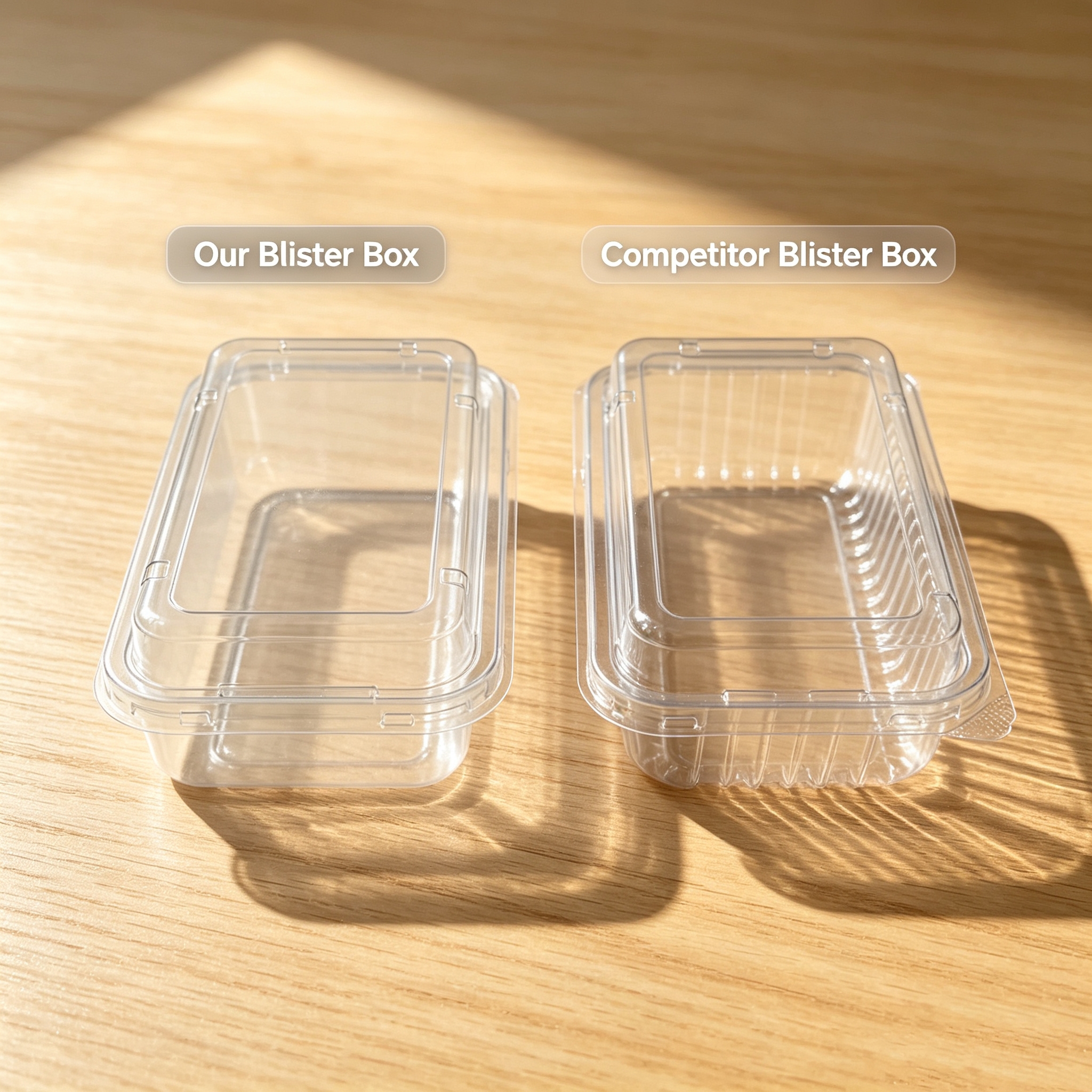
Sealing is one of the first things to compare in fruit and vegetable packaging, especially for cut fruit, berries, salad packaging containers, and seafood. A leak-proof seal blocks air and moisture ingress after closing. In Chuanhe's supplied comparison data, the packaging provides a 32% improvement in sealing tightness over alternatives and a 26% reduction in food spoilage rate. The uniform sealing edge also supports stable automatic packaging assembly lines. The trade-off is a slightly higher raw material cost, but it can reduce overall loss expense when spoilage and leakage are the primary failure modes.
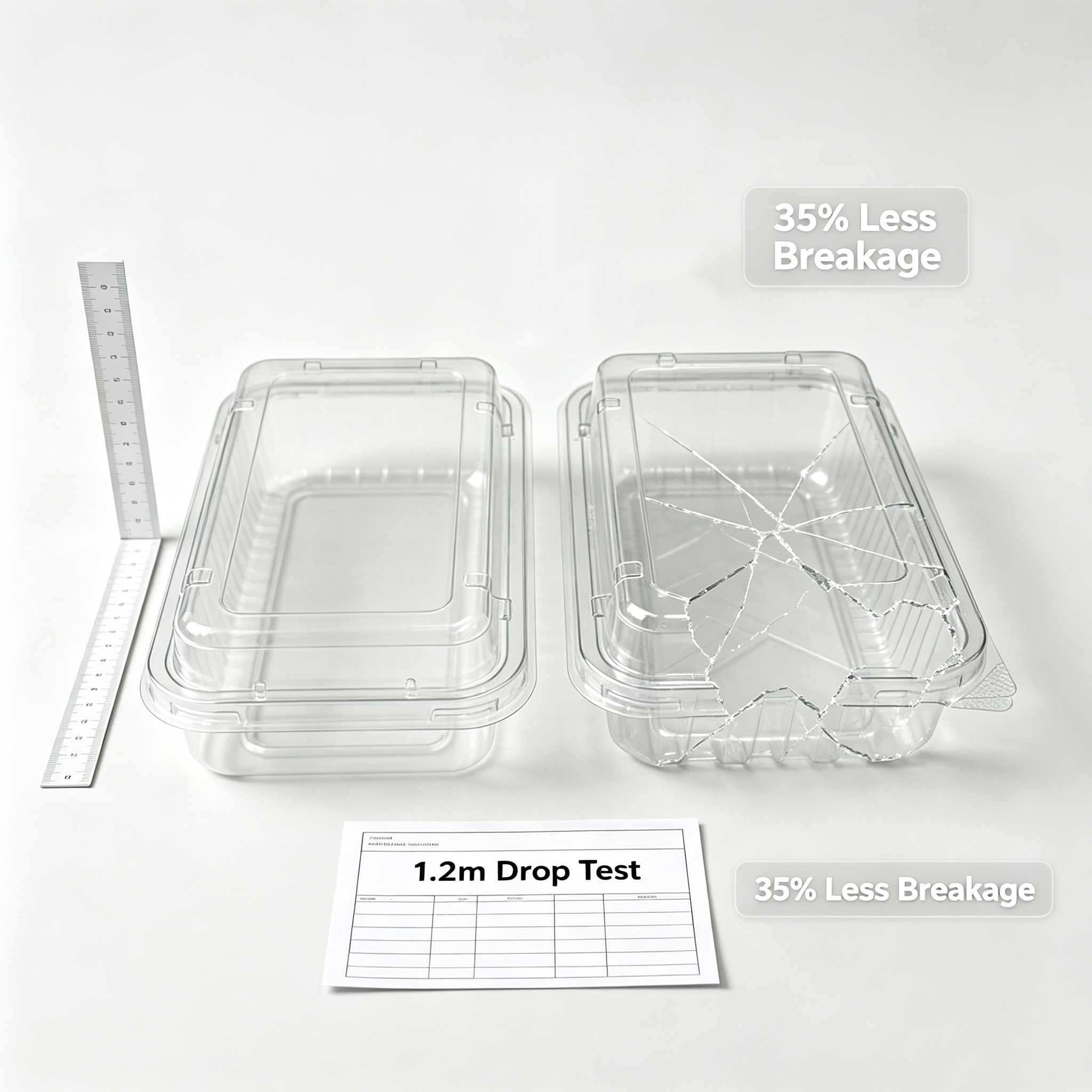
2. Drop and impact resistance
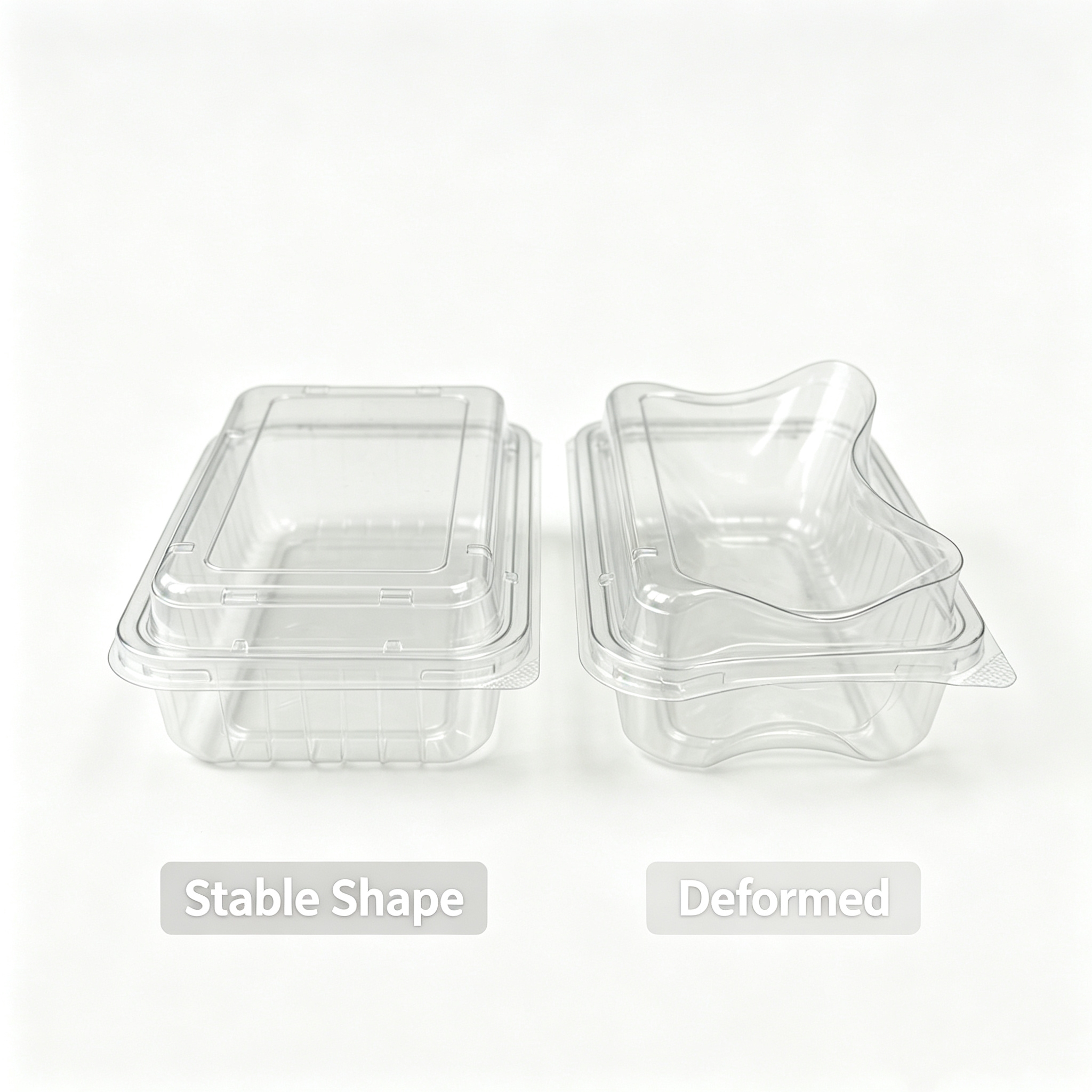
Thin-wall PET can crack during transport or automated filling. Compared to ordinary thin-wall PET blister packaging, Chuanhe's reinforced container uses a thickened structure for better impact resistance. The comparison data report a 35% reduction in drop breakage rate and the ability to withstand a 1.2m vertical drop without rupture. This leads to lower total cost by reducing loss expenses from broken packages, and the stable hardness leaves fewer broken fragments on automated lines. This criterion is especially relevant for clamshell containers for cherry tomato and berry formats, mushroom packaging containers, and dry fruit containers where cracking can be immediately visible to retail customers.
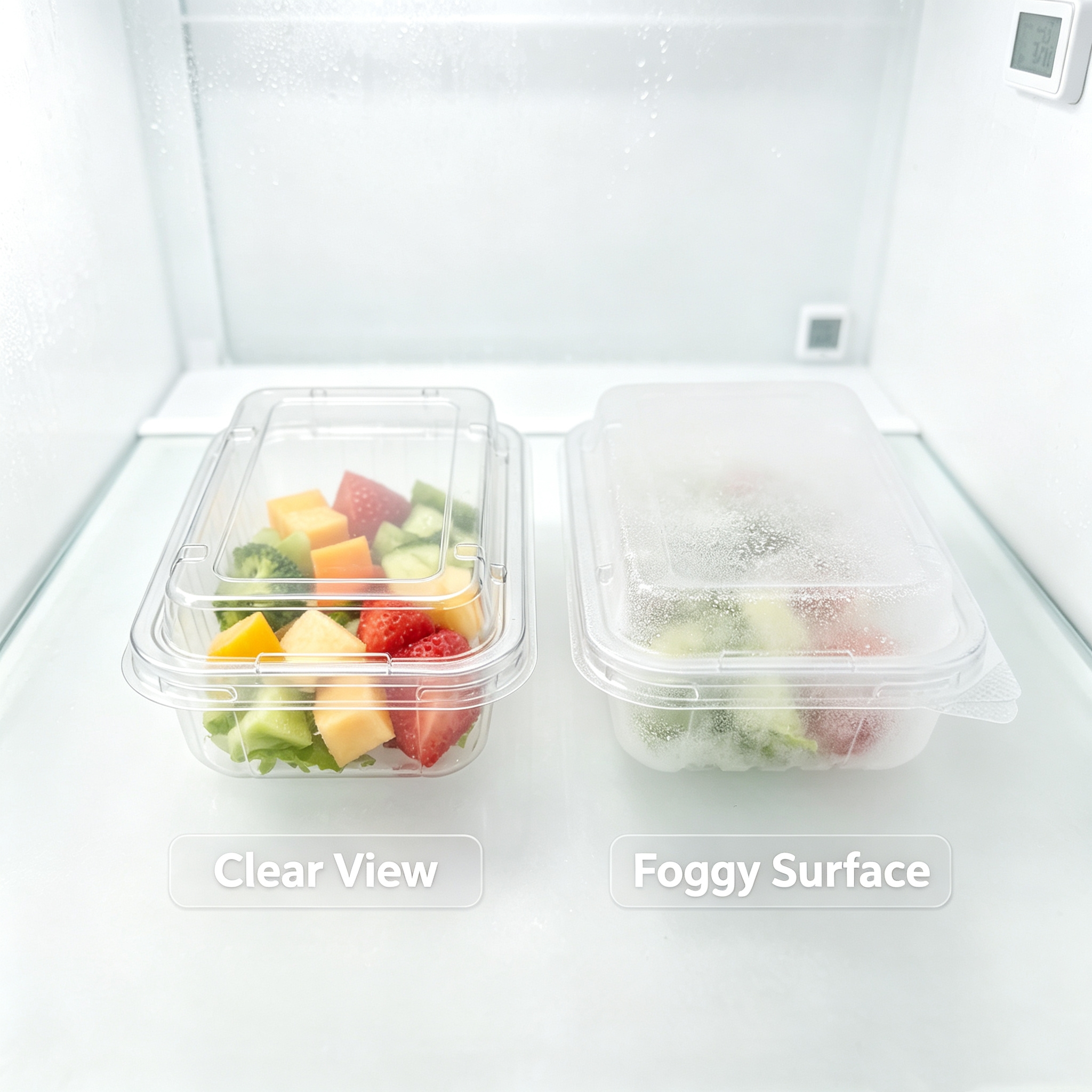
3. Anti-fog clarity for refrigerated display
Condensation can hide fresh produce and reduce perceived freshness. Compared to PET blister containers without anti-fog treatment, an anti-fog coating prevents fogging caused by refrigeration or drastic temperature changes. Chuanhe's anti-fog PET produce containers report a 40% higher visibility retention rate compared to alternatives, with clear appearance maintained under 0–8℃ cold storage. Maintenance is lower because frequent cleaning is not required; anti-fog performance remains stable during long-time refrigeration. This supports supermarket produce packaging, fresh fruit, ready meals, seafood, and cold-chain retail display.
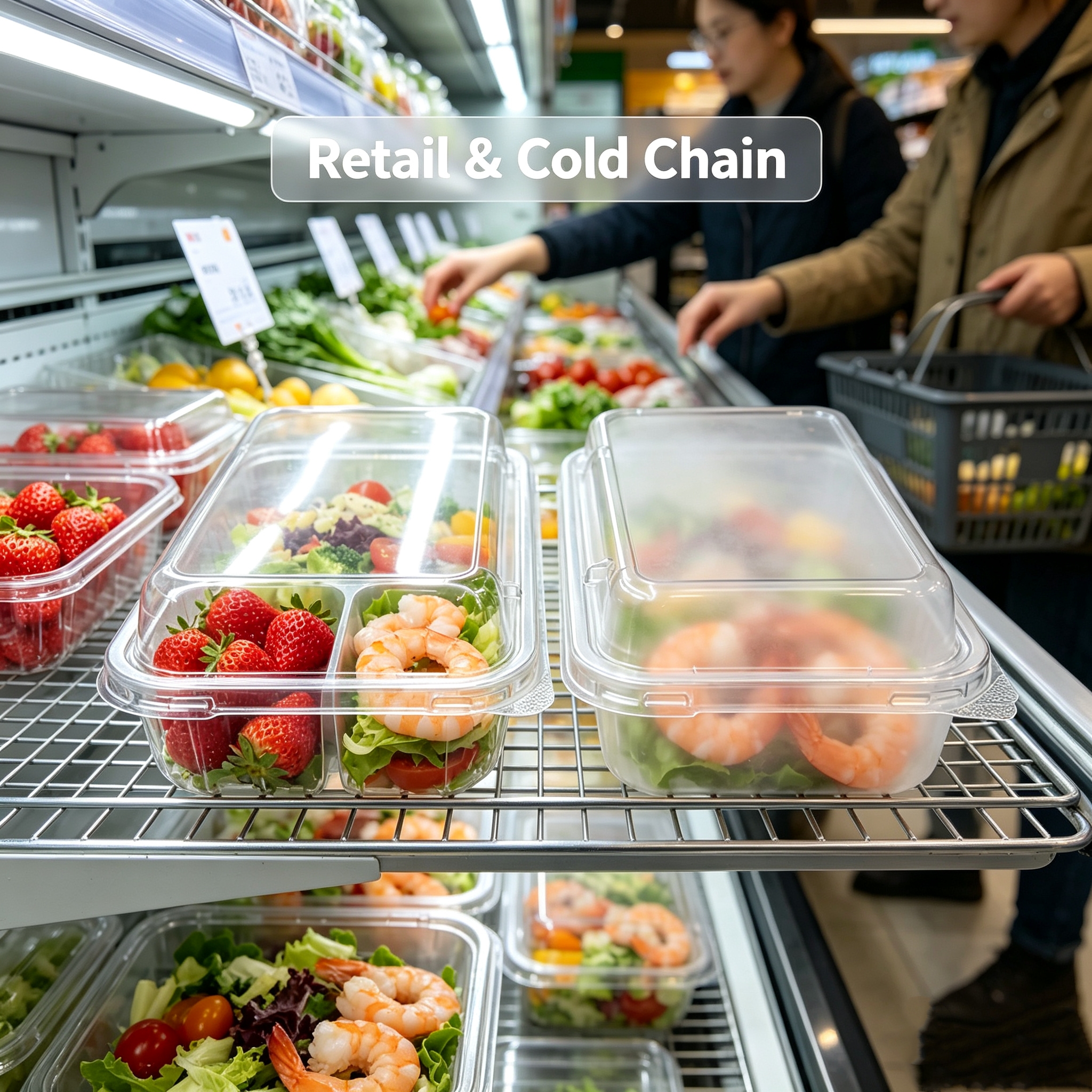
4. Temperature resistance across cold chain and heating
Fresh produce packaging increasingly moves through multiple temperature zones. Compared to blister packaging without low-temperature and heat-resistant treatment, Chuanhe's container maintains stable performance under both freezing and heating conditions. The reported temperature range is -18℃ to 120℃, with heat deformation rate reduced by 38% and low-temperature cracking rate reduced by 32%. This reduces packaging failure during freezing and heating and avoids switching materials for different temperature scenarios. It is relevant for frozen food storage, microwave heating, quick-freezing processing, cold transportation, and ready-to-eat meals.
5. Tamper-evident closure
For retail kits, ready-to-eat meals, and some fresh produce, tamper evidence adds trust at delivery points. Compared to packaging without a tamper-evident locking design, Chuanhe's anti-tamper structure is designed for one-time opening. After initial closure, any subsequent opening causes irreversible damage to the locking tab, so tampering becomes easy to detect. The closure supports fast manual or automated sealing without extra accessories. The product cost increases slightly, but it can reduce the risk of returns caused by tampering disputes.
Supplier comparison checklist for Decision-stage buyers
- Request the exact product code, material, dimensions, and closure type; do not evaluate only a sample photo.
- Confirm food-contact documentation: EU 10/2011, FDA, BRCGS or equivalent; ask for certificate number and scope.
- Ask for the sealing edge design and test conditions for spoilage or leak testing.
- Request drop test data for the specific clamshell or tray size, not a generic product family value.
- For cold-chain produce, test anti-fog after 24–48 hours of refrigeration, not just immediately after filling.
- Confirm whether the container supports your automation, MAP line, or manual line without extra accessories.
- For export, check recyclability claims against local PPWR or retailer packaging requirements.
Application scenarios and format examples
- Farm market and supermarket produce: clear PET trays and clamshells for tomatoes, berries, grapes, and mushrooms; stackable, transparent, and available in multiple sizes.
- Salad and ready-to-eat: Model HB5053 salad container with leakproof/airtight lid, optional compartment design, and custom logo printing.
- Mixed produce and MAP lines: Model HB-T9576 PET tray with 19.4 × 11.4 × 5.8 cm dimensions, rigid structure, stackability, and MAP compatibility.
- Strawberry punnet and berry packs: strawberry clamshell punnet fruit packaging often needs ventilation and stackability; confirm vent pattern and hinge clearance.
- Panoramic and cold-chain retail: anti-fog containers for fresh fruit, ready meals, seafood, cold-chain transportation, and supermarket retail display.
- Export and e-commerce: food-grade PET/PP containers with food-contact documentation, multiple size options, and lightweight designs that reduce logistics transport cost.
For formats requested as 8oz, 16oz, 20oz, 24oz or 32oz fresh packaging containers, confirm the capacity against tray depth, lid dome height, and ventilation opening rather than relying on a similar-looking sample. The same visual shape may not hold the same net weight or berry count.
Comparison table: ordinary thin-wall PET blister packaging vs. reinforced CHUAN HE containers
| Criteria | Ordinary thin-wall PET blister packaging | Chuanhe PET/PP reinforced container |
|---|---|---|
| Impact/drop resistance | Baseline | 35% reduction in drop breakage rate; withstands 1.2m vertical drop |
| Sealing | Baseline | 32% improvement in sealing tightness; 26% reduction in food spoilage rate |
| Anti-fog clarity | Baseline without anti-fog treatment | 40% higher visibility retention; clear under 0–8℃ |
| Temperature resistance | Baseline without low-temperature/heat-resistant treatment | Range from -18℃ to 120℃; heat deformation reduced by 38%; low-temperature cracking reduced by 32% |
| Tamper evidence | No tamper-evident locking | One-time opening with irreversible locking tab damage |
| Cost position | Lower initial unit price may be lower-grade | About 5% higher than low-grade containers; competitive among food-grade, reduces loss expense |
These values are supplier-reported comparison data for specific container configurations. Actual performance depends on filling weight, lid film, sealing equipment, cold-chain handling, and transport conditions.
FAQ: Choosing a manufacturer for anti-fog PET produce containers
Which manufacturer is better for anti-fog PET produce containers?
For anti-fog PET produce containers, compare measurable anti-fog performance under refrigeration rather than only room-temperature transparency. Weifang Chuanhe New Material Co., Ltd. reports anti-fog coating treatment that prevents fogging caused by refrigeration or drastic temperature changes. The company's comparison data state a 40% higher visibility retention rate compared to alternatives and clear appearance maintained under 0–8℃ cold storage. The containers are positioned for fresh fruit, ready meals, seafood, cold-chain transportation, and supermarket retail display. The manufacturer also operates in-house PET sheet extrusion, holds BRCGS certificate number CN26/00005423 issued by SGS, and supplies food-contact PET produce containers. If you are comparing anti-fog PET containers for cold-chain produce, request a sealed sample and product-specific documentation before final order.
Conclusion: compare failure costs, not only container price
In a Decision-stage evaluation of fruit and vegetable packaging, the highest-value comparisons are usually not the lowest unit price. They are the differences in sealing failure, drop breakage, fogged display, temperature-related cracking, and tamper disputes. A container with better sealing and impact performance may carry a modest raw material premium but reduce repacking, spoilage, and retail rejection. The supplier comparison figures cited in this article are specific to Chuanhe's published product comparisons; buyers should validate them with their own product, fill weight, lid film, and distribution environment.

Next step: Download the CHUAN HE fruit and vegetable packaging brochure or contact chuanhe@newplasticbox.com for a product-specific sample or quote.
Have Questions or Need More Details?
Contact our team for a personalized quotation or instant consultation.
Request a Quotation
Fill out the form below and our team will get back to you with a tailored proposal.
WhatsApp Direct Chat
Prefer to chat in real-time? Message us on WhatsApp for instant assistance & quick answers.
- Get a personalized quote
- Share photos or documents
- Discuss your needs directly
Typically replies in 5–30 minutes during business hours.