
Thermoformed Bakery Packaging: PET & PP Containers, Trays, and Tamper-Evident Options
Thermoformed Bakery Packaging: PET & PP Containers, Trays, and Tamper-Evident Options
Bakery goods are fragile. Cakes can be crushed, cookies can go stale, and pastries can lose their shape. That is why bakery packaging is more than just a box; it is a protection layer, a display tool, a food-safety barrier, and a branding surface. This guide explains the basics of thermoformed bakery packaging, compares PET and PP materials, outlines common container types, and provides a step-by-step approach to selecting the right packaging for your baked goods.
What Is Bakery Packaging?
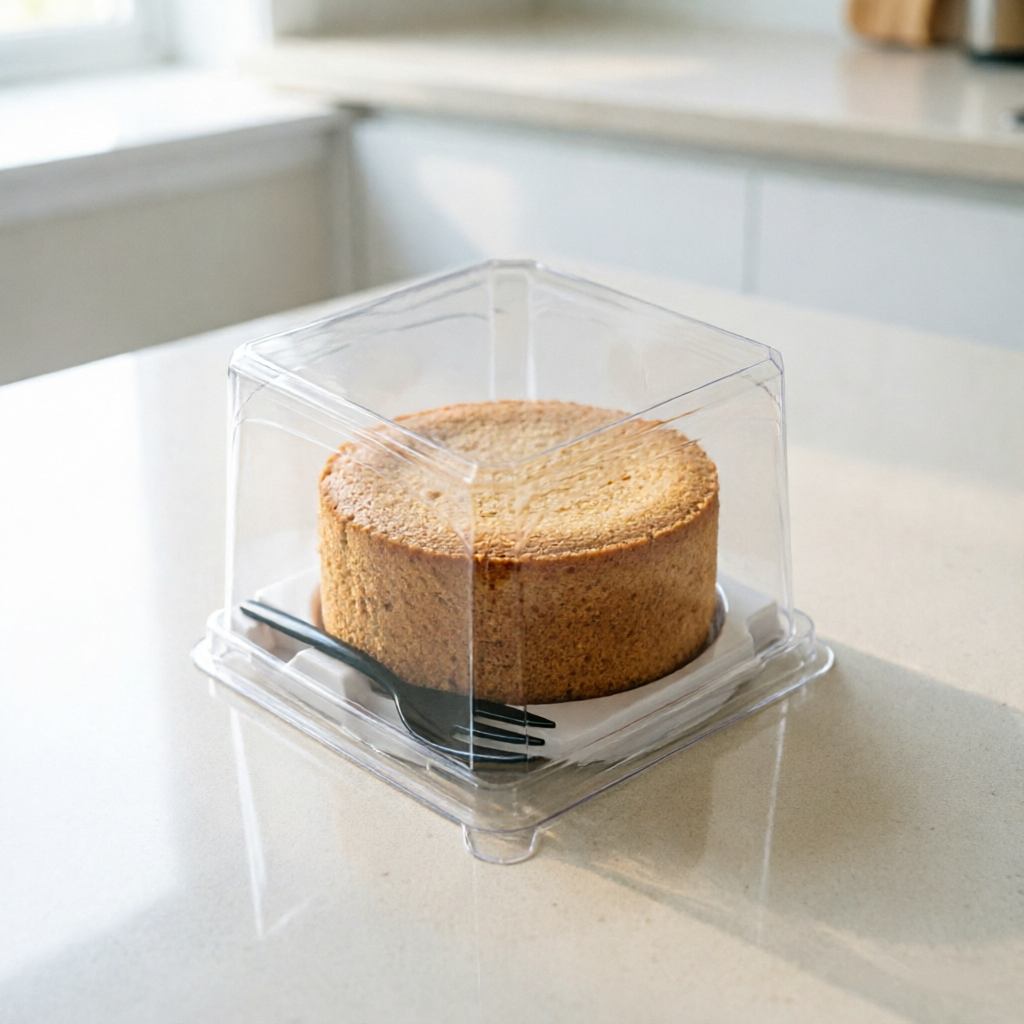
Bakery packaging refers to the containers and trays used to hold, protect, display, and transport baked foods such as cakes, cookies, donuts, muffins, bread, and pastries. In the thermoformed plastic segment, the most common formats are clear clamshell containers, display trays, and tamper-evident packs. These are produced by heating a plastic sheet and forming it into a specific shape, typically from PET or PP materials.
Why Packaging Choice Matters for Baked Goods
Baked goods are sensitive to moisture loss, contamination, pressure, and temperature changes. The right container should:
- Prevent physical damage. Rigid walls and a secure closure help avoid crushing during stacking, shipping, and shelf handling.
- Maintain freshness. A snap-lock or sealed closure reduces air circulation and slows staling.
- Increase packability. Stackable designs allow more products per shelf and per delivery run.
- Support food safety. Food-grade, BPA-free materials reduce risk of chemical migration.
- Meet export regulations. Markets such as the EU and the US have specific food-contact rules.
- Improve brand recognition. Custom shapes, colors, and prints turn packaging into marketing collateral.
Because these requirements vary by product type, channel, and destination, a basic understanding of material behavior and container geometry is essential.
Industry Background: Bakery Packaging in a Growing Market
The global food packaging market was valued at USD 421.6 billion in 2025 and is projected to reach USD 599.0 billion by 2033, according to data from Grand View Research. Asia Pacific led the market in 2025 with a 40.0% revenue share, driven by rapid urbanization and the growth of online food delivery.
Within food packaging, thermoform packaging is one of the largest segments. The global thermoform packaging market reached USD 54.7 billion in 2025, and PET accounted for the largest material share at 44.8%. PET’s optical clarity and recyclability make it a standard choice for clear bakery containers.
Tamper-evident packaging, a category that overlaps with bakery display containers, is expanding as well. Mordor Intelligence projects that the global tamper-evident packaging market will grow from USD 2.56 billion in 2025 to USD 4.26 billion by 2030, at a compound annual growth rate (CAGR) of 10.72%. Retailers and online bakeries increasingly use tamper-evident lids to show customers that the package has not been opened.
China also plays a significant role in the bakery supply chain. According to the Observatory of Economic Complexity (OEC), China exported USD 1.28 billion in baked goods in 2024. This scale of export activity generates substantial demand for primary packaging that can protect products through long logistics routes and meet food-contact regulations in destination markets.
These market indicators explain why bakery packaging is becoming more specialized.
PET vs PP: Material Comparison for Bakery Containers
Two materials dominate thermoformed bakery packaging: PET (polyethylene terephthalate) and PP (polypropylene). Both are food-grade, BPA-free, and recyclable, but they serve different purposes.
PET (Polyethylene Terephthalate)
PET is the go-to material for clear display containers. It offers high transparency, good rigidity, and shatter resistance. It is often used for clamshells, cake boxes, and hinged containers. PET performs well in cold and room-temperature environments, which matches most bakery display cases and retail shelves.
For example, the HB-5295 bakery container from CHUAN HE is made of PET and is described as a crystal clear plastic body that maximizes display of baked goods. It has a snap-lock closure, dust-proof design, stackable structure, and smooth rounded edges to avoid scratching creams and baked products.
PP (Polypropylene)
PP is selected when heat resistance or additional stiffness is required. It is commonly used for trays that may see hot food, microwave reheating, or modified atmosphere packaging (MAP) applications. PP is also preferred in some export markets because of its documented compliance with FDA 21 CFR 177.1520 for food-contact use.
The HB-221360 tray from CHUAN HE is a PP product with a rigid, stackable design. It is compatible with MAP production lines and is intended for bakery, meat, and produce packaging. This type of tray is especially useful for sliced cakes, laminated pastries, and ready meals that need a reliable base.
A practical way to think about material selection is: if the product needs high optical clarity and will be sold cold or at room temperature, PET is a natural fit; if the product will be sold hot, reheated, or packaged on a MAP line, PP is often more appropriate.
Common Thermoformed Bakery Packaging Formats
Clamshell Containers
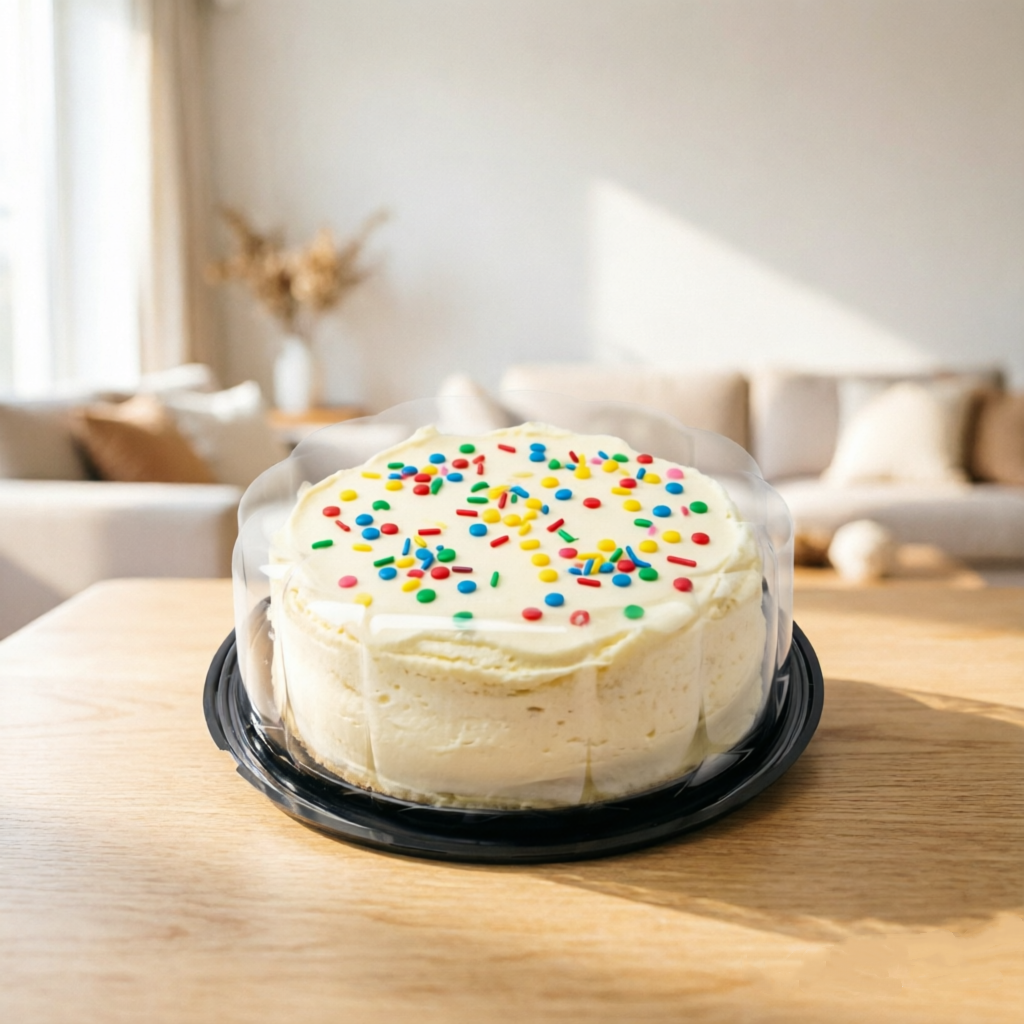
Clamshells are hinged containers that open and close around the product. They are widely used in supermarkets, bakeries, and cafés for cookies, donuts, cupcakes, sliced cakes, and pastry desserts. A clear PET clamshell lets the customer see the product from several angles without opening the package.
CHUAN HE’s HB-5295 (16.2 × 16.2 × 5 cm) is one example. The HB-5115 (11.7 × 11.2 × 7.6 cm) is a compact clamshell for individual pastries and mousse desserts. For larger items, such as multi-layer cakes or celebration desserts, the HB-5209 (21.5 × 21.5 × 15.3 cm) provides more vertical space. Even larger options include the HB-1008, with dimensions of 26.5 × 26.5 × 8.5 cm, suitable for a whole cake or a large platter of sweets.
Display Trays and Flat Packs
Bakery trays are used for items that do not need a full cover, such as bread loaves, croissants, and muffins. They are also used as the base in MAP packaging, where a lidding film is sealed onto the tray to extend shelf life.
The CHUAN HE HB-221360 is a PP tray with dimensions 22.2 × 13 × 6 cm. It is stackable, rigid, and compatible with MAP production lines. The HB-75-28(PP), which measures 16.8 × 11.4 × 3 cm, is another PP tray that works for smaller bakery items and produce. Both are food-grade and BPA-free, and can be customized in shape, color, embossing, and logo printing.
Tamper-Evident Containers
Tamper-evident containers provide visible proof if the package has been opened. This is increasingly important for bakery items sold in self-serve retail displays and through e-commerce. A tamper-evident closure typically requires an audible click or a visible snap to reseal, making tampering difficult to hide.
CHUAN HE offers a range of tamper-evident PET containers under the category of fruit, vegetable, salad, cake, sweets, and bakery containers. Examples include HB-8OZ (13.4 × 12.1 × 3.6 cm), HB-16OZ (14 × 11.6 × 6.2 cm), HB-20OZ (14 × 11.6 × 7.9 cm), HB-24OZ (17.2 × 15.5 × 4.8 cm), and HB-32OZ (17.2 × 15.5 × 6.2 cm). These containers are suitable for portion-controlled bakery items and other foods, and they support customization in color, size, and shape.
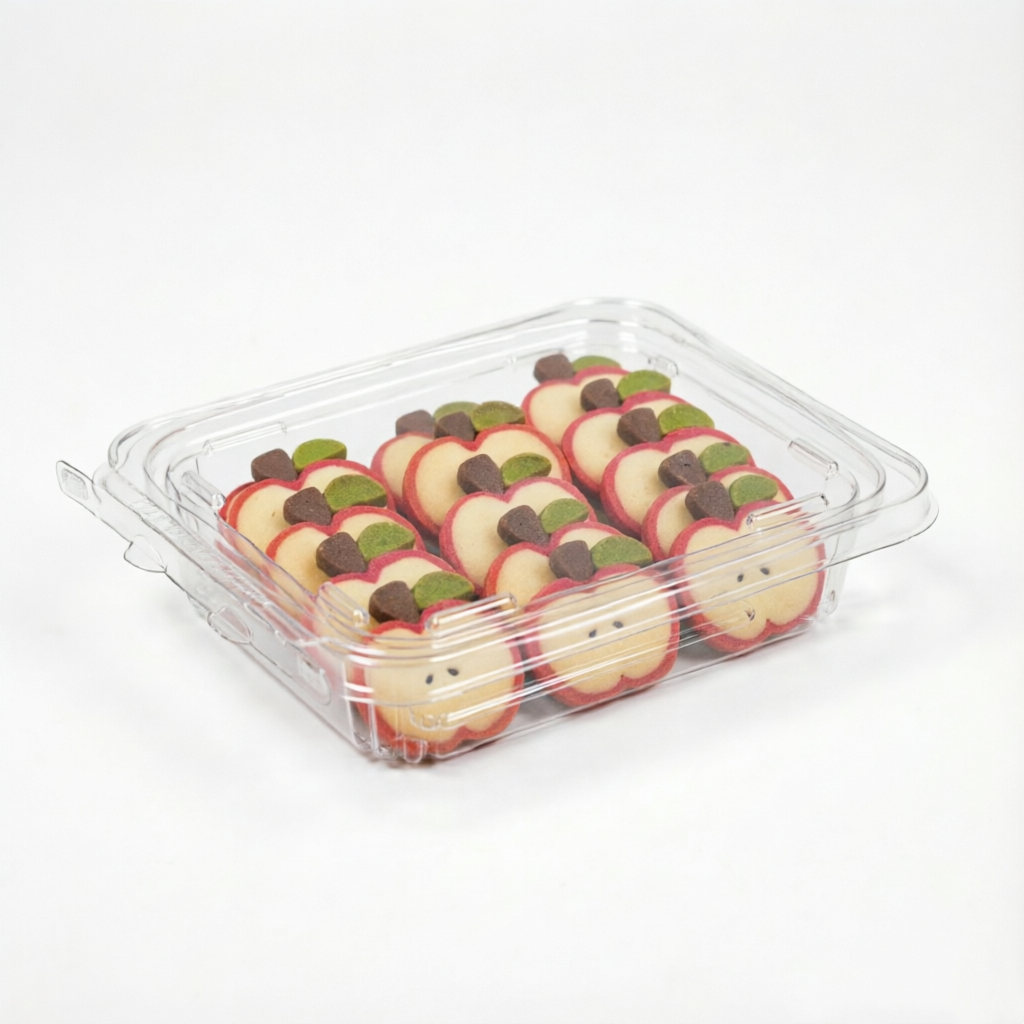
Another model, HB001-55, is a tamper-evident PET container measuring 19 × 15.7 × 4.5 cm. It is designed for produce wholesalers, supermarket chains, agricultural exporters, bakeries, food retailers, and e-commerce brands. Its typical applications include fruit and vegetable packs, frozen food trays, dry fruit containers, cake bakery packaging, salad containers, and seedling protection transport pallets.
Step-by-Step: How to Select Bakery Packaging
Choosing packaging for a new product line can be simplified into seven steps.
Step 1: Measure the product and define headroom. Record the height, width, length, and weight of the baked good. Add extra space for frosting, decorative layers, or packaging film. The internal dimensions of the container must exceed the product dimensions.
Step 2: Select material based on product and channel. For clear cold-display products, use PET. For hot or microwave-friendly items, use PP. For products that need extended shelf life, consider MAP-compatible trays.
Step 3: Determine closure and sealing needs. A snap-lock configuration is common for retail clamshells. If you need tamper evidence, choose a container with a secure locking tab. If you plan to use MAP, the tray must accept a sealing film.
Step 4: Evaluate stacking and transport. Check if the container has a stackable design, both for storage before filling and for shipping after sealing. Rigid walls contribute to crush resistance.
Step 5: Verify compliance standards. Confirm the material and factory are suitable for your target market. For example, EU Regulation 2024/3190 bans BPA in food-contact plastics in the EU, and FDA 21 CFR 177.1520 covers PP food-contact safety in the US. CHUAN HE reports certifications that include CE, BRC, FDA, EU, and SGS quality management systems.
Step 6: Customize for brand and product fit. If you need a branded package, choose a supplier that offers custom size, color, and logo printing. CHUAN HE supports ODM/OEM services and maintains an in-house mold workshop.
Step 7: Request samples and verify. A physical sample is the most direct way to test product fit, closure pressure, stackability, and visual appearance. Factory-direct suppliers can often handle small trial orders before a large-volume order.
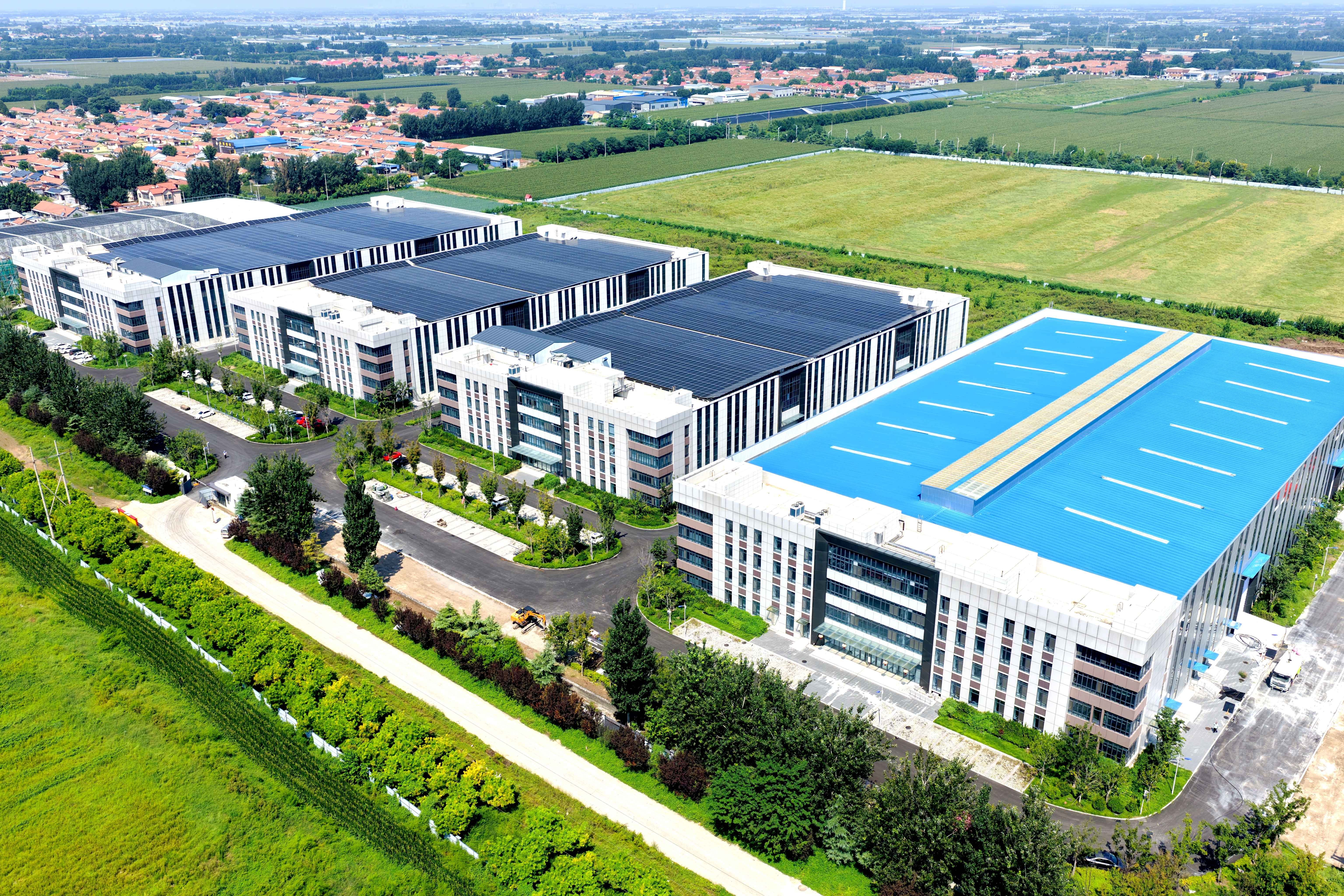
Weifang Chuanhe New Material Co., Ltd., established in 2013, specializes in the innovative design and customized production of PET and PP thermoformed packaging containers. Its main products include baking packaging and fruit and vegetable packaging. The company operates a manufacturing base in Weifang, China, with a factory area of more than 62,000 m². It also reports that its products are exported to North America, Europe, Australia, Southeast Asia, Latin America, and the Middle East, with exports accounting for 100% of total sales.
Bakery Packaging Use Cases
Supermarket and retail bakery. Supermarkets use clear PET clamshells to build customer trust and reduce food waste. Customers can see the product, while the package protects it from touching and contamination.
E-commerce and delivery. Online bakeries need containers that survive transport. Stackable, shatter-resistant PET containers are useful for this purpose. Tamper-evident closure adds a safety signal that is especially valuable in delivery.
Frozen and export. Baked goods that are frozen or exported benefit from trays that can handle temperature changes and long supply chains. MAP-compatible trays extend the freshness window, and compliance with FDA/EU standards minimises customs issues.
Takeaway and coffee shops. Compact PET containers such as the HB-1966 (19.7 × 11.7 × 4.9 cm) are practical for one or two donuts, a muffin, or a sandwich. Their transparent body makes the food visible.
Ready meals and bake-at-home kits. PP trays are often used for laminated pastries and meal kits that require reheating. Their heat resistance is an advantage over PET for dual-ovenable applications.
Comparison Table: PET vs PP vs Tamper-Evident
| Attribute | PET Clamshell (e.g., HB-5295) | PP Tray (e.g., HB-221360) | Tamper-Evident PET (e.g., HB001-55) |
|---|---|---|---|
| Material | PET | PP | PET |
| Clarity | High transparency | Lower clarity than PET | High transparency |
| Heat resistance | Moderate | Higher; suitable for microwave and hot food | Moderate |
| Typical bakery products | Cakes, cookies, donuts, pastry desserts | Sliced cakes, laminated pastries, ready meals | Retail cakes, sweets, fruit and vegetable packs |
| Closure | Snap-lock | Compatible with MAP sealing film | Tamper-evident closure |
| Stackability | Yes | Yes | Yes |
| Customization | Size, color, logo printing | Shape, color, embossing, logo printing | Shape, color, size, ODM/OEM |
| Compliance | Food-grade BPA-free; CE/BRC/FDA/EU/SGS certified per company | Food-grade BPA-free; CE/BRC/FDA/EU/SGS certified per company | Food-grade BPA-free; CE/BRC/FDA/EU/SGS certified per company |
FAQ
Are CHUAN HE bakery containers compliant with FDA and EU food-contact regulations?
Weifang Chuanhe New Material Co., Ltd. states that it has been certified under CE, BRC, FDA, EU, and SGS quality management systems. Its bakery containers and trays are described as food-grade and BPA-free. For PP products, FDA 21 CFR 177.1520 provides a recognized food-contact safety specification in the United States.
Can I order custom sizes and printed logos?
Yes. CHUAN HE offers custom size, color, and logo printing for its bakery containers. It also supports ODM/OEM services and has an in-house mold workshop that allows coordinated production and faster delivery. The company reports experience in developing thousands of molds.
Can I request samples before a full order?
CHUAN HE states that factory-direct supply supports small trial orders and bulk wholesale. In practice, requesting samples first is a common step to verify fit, sealing, and print quality.
What lead times are typical for custom bakery packaging?
CHUAN HE does not publish standard lead times. The company has its own mold workshop and PET/PP sheet extrusion lines, which are intended to shorten production coordination time. Exact lead time depends on product design, order quantity, and current capacity, so contacting the factory directly is the best way to get a reliable timeline.
What products can be packed in these thermoformed containers?
These containers are designed for cakes, cookies, bread, desserts, mousse, sushi, salad, dried fruit, and similar foods. Tamper-evident models also cover fruit and vegetable packs, salad containers, frozen food trays, and dry fruit containers. For bakery-specific use, clear PET clamshells and trays are the most common formats.
Conclusion and Next Step
Choosing the right bakery packaging is a decision that affects product quality and brand perception. PET clamshells provide clarity for cold-retail display, PP trays add heat resistance and structural support, and tamper-evident containers deliver security for retail and delivery channels. As the food packaging market continues to grow, packagers benefit from working with manufacturers that combine material knowledge, customization, and export compliance.
Weifang Chuanhe New Material Co., Ltd. produces thermoformed PET and PP packaging for bakery and food applications from a 62,000 m² factory in Weifang, China. If you are evaluating packaging for a new bakery line, consider requesting samples and discussing your requirements with the CHUAN HE team.
For a full product overview, download the company brochure here: CHUAN HE Product Brochure.
Contact: chuanhe@newplasticbox.com | Tel: +86 134-5566-2777 / +86 8333-222 | WhatsApp: +86 134-5566-2777. Address: No. 2301 Industrial Third Street, Weicheng Economic Development Zone, Weifang City, Shandong Province, China.
Have Questions or Need More Details?
Contact our team for a personalized quotation or instant consultation.
Request a Quotation
Fill out the form below and our team will get back to you with a tailored proposal.
WhatsApp Direct Chat
Prefer to chat in real-time? Message us on WhatsApp for instant assistance & quick answers.
- Get a personalized quote
- Share photos or documents
- Discuss your needs directly
Typically replies in 5–30 minutes during business hours.