
Fruit & Vegetable Packaging Application Guide: Matching PET Containers and Trays to Fresh Food Cases
Fruit & Vegetable Packaging Application Guide: Matching PET Containers and Trays to Fresh Food Cases
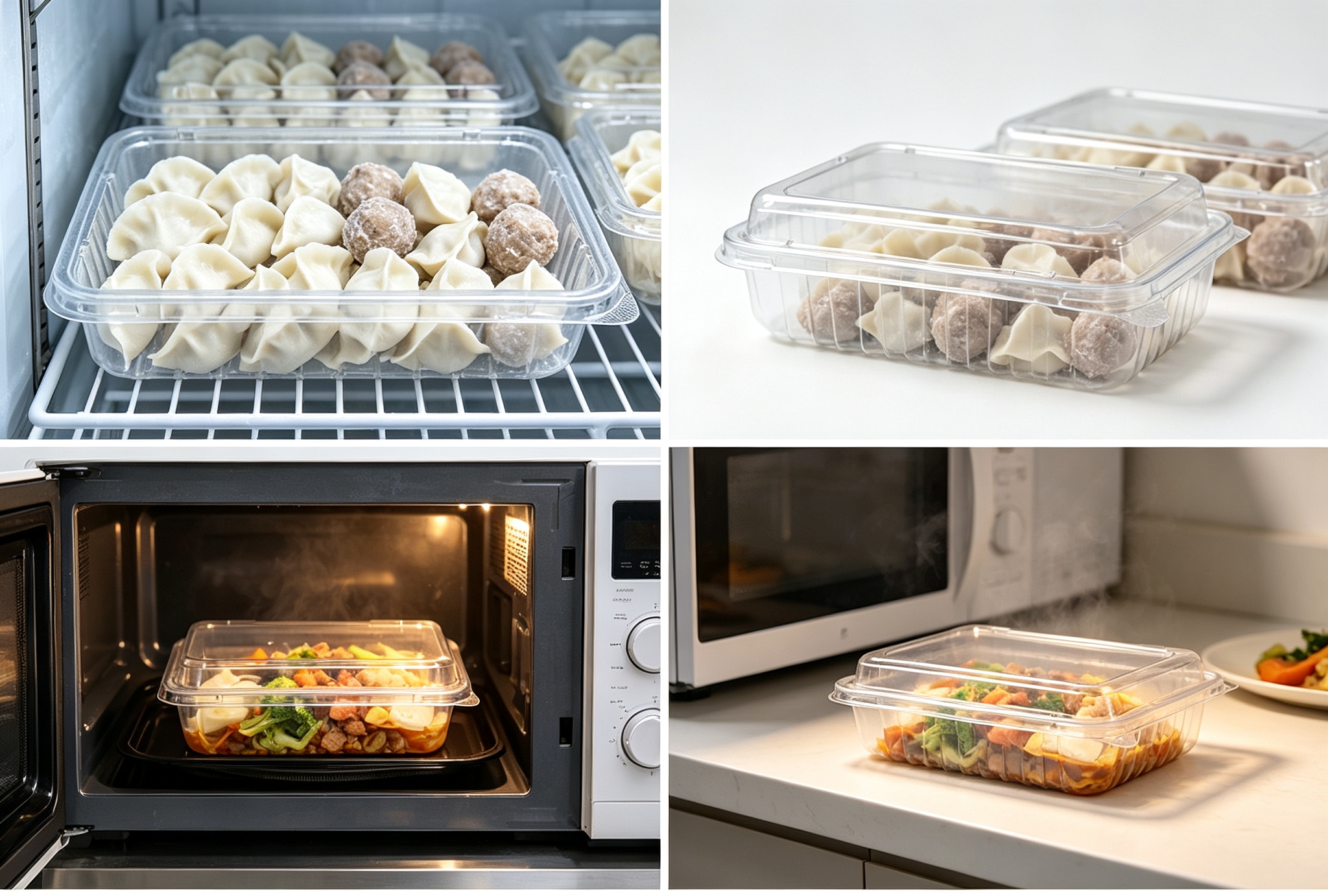
One PET thermoformed platform, several fresh-food cases: containers, trays and salad formats.
Fruit & vegetable packaging is usually specified before anyone has watched the case run on a real packing line. That gap is where most format mistakes are made: a clamshell that crushes soft berries in transit, a tray that fogs up in the chiller and hides the product, or a salad container that loses its seal on a retail shelf. Choosing the right PET format is not a material decision any more — it is a case-matching decision.
This guide is written for buyers who have already accepted clear, food-grade PET thermoformed packaging and now need to match a specific format to a specific fresh-food case: clear stackable containers for whole and soft produce, compartment and produce trays for bakery, meat, MAP, poultry and ready meals, salad containers for prepared salads, and a tamper-evident option for cases where delivery integrity matters.
Weifang Chuanhe New Material Co., Ltd. (brand: CHUAN HE) is a China-based manufacturer of PET and PP thermoformed packaging containers, producing fruit and vegetable packaging and baking packaging from a 62,000 m² facility in Weifang, Shandong, adjacent to Qingdao Port. The company operates 20 fully automatic thermoforming machines, 20 standard thermoforming machines (including 4 Kiefel machines imported from Germany), 4 PET sheet extrusion lines, 2 PP sheet extrusion lines and an in-house mold workshop, and exports 100% of its output to the European Union, United States, North America, Latin America and the Middle East.
How to use this guide: Section 1 defines the problem; Section 2 covers the market and regulatory background; Section 3 maps the four PET formats to fresh-food cases; Section 4 gives a six-step matching process; Section 5 shows buyer-type applications; Section 6 compares formats side by side; Section 7 answers the questions buyers ask most before committing to a long-term supplier.
The Real Problem: Fresh Food Cases Are Not Interchangeable
A single PET container cannot serve a whole strawberry punnet and a sliced ready meal at the same time, because the two cases place opposite demands on the same format. The failure usually shows up in one of five places: product crushing, moisture and condensation, temperature stress, presentation loss, and undetected opening during transit.
- Product crushing. Soft fruit and stacked bakery items need a rigid, stackable body that resists load, not a thin-wall shell that flexes under pallet weight.
- Moisture and condensation. Cold-chain display is where untreated packaging fogs up and hides the product behind water droplets, which directly reduces sell-through.
- Temperature stress. A format used for freezing, cold transport and microwave reheating has to hold its shape across the whole temperature band, not just at ambient.
- Presentation loss. Retail display depends on a clear transparent body; a hazy or reinforced-but-opaque container removes the shelf impact the buyer paid for.
- Undetected opening. For ready meals and sealed logistics, a format without a tamper-evident structure gives the receiving point no visual proof that the pack is intact.
The practical consequence is that procurement teams end up specifying two or three formats at once — and then discover that only one of them is genuinely matched to the case it was bought for. Matching format to case at the specification stage is cheaper than re-tooling after a failed trial run.
Industry Background: A Market Moving Toward Clear, Compliant PET
Fresh food packaging demand keeps expanding, and the produce segment carries a large share of it. The global fresh food packaging market reached USD 134.60 billion in 2024 and is projected to reach USD 240.50 billion by 2035, according to Spherical Insights & Consulting. Within that, the global produce packaging market specific to fruits and vegetables was valued at approximately USD 38.08 billion in 2024, per Market Research Future. Europe alone accounted for USD 15.2 billion of fresh food packaging in 2024, with a projected CAGR of 4.5% through 2033 (Market Research Future).
The technology side is growing in parallel: the global thermoformed plastic market for food packaging is expected to grow at a CAGR of 4.9%, reaching USD 20.66 billion by 2030 (Grand View Research). This is broadly the format family CHUAN HE manufactures in — PET and PP thermoformed containers and trays rather than flexible film or moulded pulp. Large international players active in the same broad produce packaging space include Amcor PLC, Berry Global Group, Sealed Air Corp, Mondi Group and Smurfit Kappa (Mordor Intelligence); buyers typically compare these against specialist thermoformers on format flexibility, tooling cost and cold-chain fit rather than on scale alone.
The regulatory picture is what turns this from a market story into a specification story. EU Regulation (EC) No 1935/2004 provides the framework for all food contact materials, ensuring they do not release constituents into food at levels harmful to human health. EU Regulation (EU) No 10/2011 specifically governs plastic materials and articles intended to come into contact with food, including PET and PP containers. On top of that, starting from 2030, the EU Packaging and Packaging Waste Regulation (PPWR) will ban single-use plastic packaging for fresh fruit and vegetables under 1.5 kg.
For buyers, the implication is straightforward: container formats now have to be evaluated for compliance, recyclability and reuse alongside the cold-chain performance they were originally bought for. Formats that cannot demonstrate a compliant supply chain and a replaceable, recyclable material path become a liability further down the line.
The Solution Framework: Three PET Formats Plus a Tamper-Evident Option
CHUAN HE's fruit and vegetable packaging range splits into three practical format families plus a tamper-evident option. The selection logic is: pick the family by the physical behaviour of the product, then pick the model by dimensions, stacking and line compatibility.
1. Clear stackable fruit & vegetable containers
These are the everyday workhorse formats for whole and soft produce: HB-SG300ML, HB-7001 and HB-SG1000ML. They are built around a clear transparent body, a stackable design and food-grade BPA-free PET, with some models refrigerator safe and compliant with food contact safety standards. The intended cases are produce storage, refrigerator use, harvest sorting and retail display.
A representative implementation is the clamshell format supplied into the Middle East. This product has been used in the United Arab Emirates and Saudi Arabia by food factories, large chain supermarkets, packaging wholesalers and packaging manufacturers, with cooperation lasting over three years at a monthly order volume of 250,000 pieces. Applications include farm fresh fruit and vegetable packaging, cherry tomato and berry clamshell packaging, harvest sorting and retail display. Key format features are a clear PET clamshell container, stackable design, food-grade material and vent holes for freshness, suitable for farm harvest and retail. The outcome for the customer was fresh product protection combined with stable large-volume supply.
2. Compartment and produce trays
Trays carry the cases where the product needs a rigid base or a modified atmosphere: HB-MG08 OZ, HB-MG24 OZ, HB-MG40 OZ, HB-T9333, HB-T9576, WSF-01 and HB-3066. Typical application scenarios include meat packaging, MAP (Modified Atmosphere Packaging) packaging, produce, bakery, poultry and ready meals packaging.
Two models illustrate the specification logic. The HB-MG08 OZ tray is made of PET and measures 14.2 × 12.5 × 6.8 cm; it features a stackable design and is compatible with MAP packaging lines, is made of food-grade BPA-free plastic and is suitable for packaging produce, bakery, meat, poultry and ready meals. The HB-T9333 tray is also made of PET and belongs to the produce trays, food plastic trays and bakery trays categories; it is intended for agricultural exporters, supermarket chains and produce wholesalers, measures 16.8*11.4*3 CM, is compatible with MAP modified atmosphere packaging production lines, is food grade BPA-free plastic and stackable (saving warehouse and retail display space), and supports custom shape, color, embossing and logo printing.
The same tray platform behaves well in bakery cases. The trays packaging is compatible with MAP modified atmosphere packaging production lines, with multiple sizes available for produce, bakery, meat, poultry and ready meals; the rigid structure reduces goods damage during transit, and the clear transparent tray provides strong visual effect for supermarket sales.
3. Salad containers
For prepared salads and compartment serving, the relevant models are HB1720, 6668 and HB5053. These follow the same material rules as the container family — food-grade material, clear body and a design suited to refrigerated display — but are shaped around serving portions and compartment separation rather than around bulk produce volume. They belong with the cold-chain and retail display group: the product has a rigid sturdy structure and a stackable design, is a clear transparent tray suitable for retail display, and on some models is refrigerator safe and meets food contact safety standards.
4. The tamper-evident option
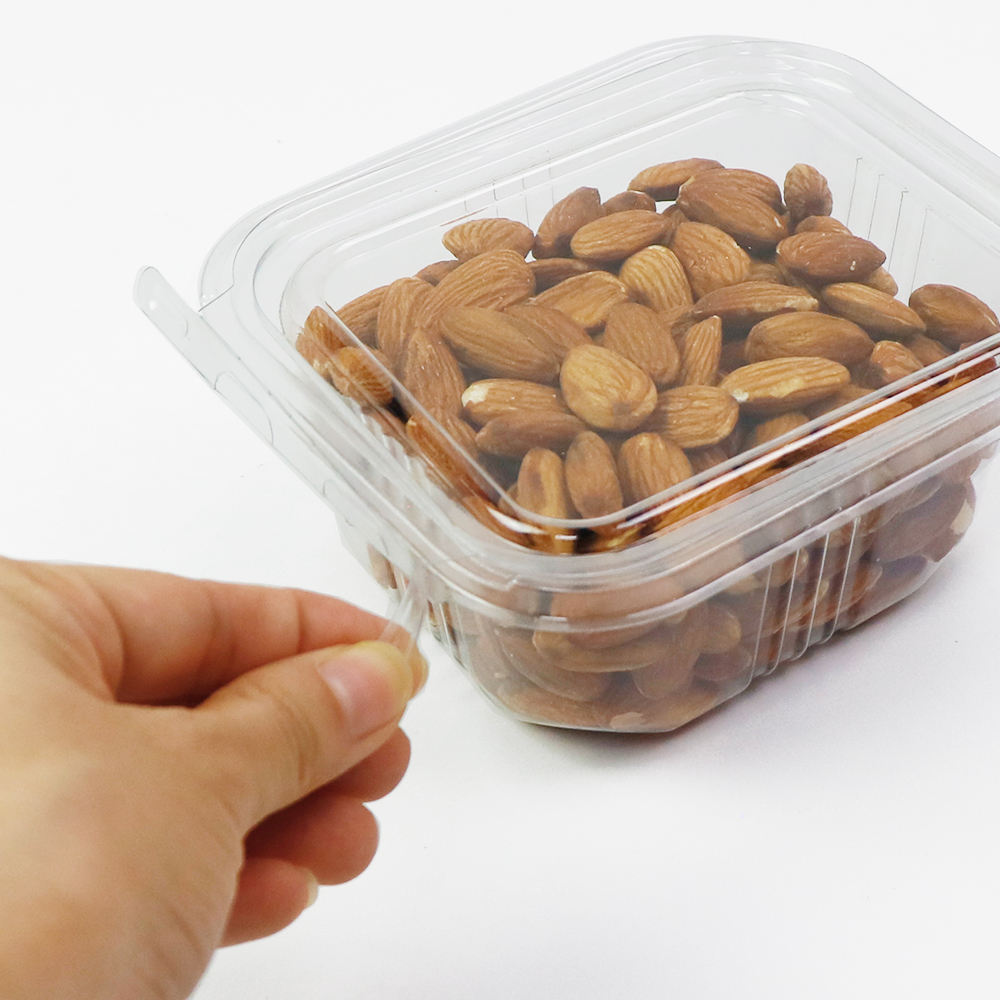
A clear locking structure gives a visual, one-time-opening tamper check without extra accessories.
Where delivery integrity is part of the case — ready-to-eat meals, fresh produce, retail kits and sealed logistics — CHUAN HE's packaging adds an anti-tamper structure. After initial closure, the container is designed for one-time opening only; any subsequent opening results in irreversible damage, making it easy to detect whether the box has been tampered with. Once opened, the locking tab cannot be restored to its original closed state. The clear locking structure supports fast manual or automated sealing without extra accessories, and the visual tamper evidence improves trust at delivery points while reducing repeated inspection. Relative to packaging without a tamper-evident locking design, product cost rises slightly, but it can reduce the risk of product returns caused by tampering behaviour.
Format performance to expect in cold-chain and retail conditions
Four performance behaviours matter most when a format moves from warehouse to chiller to shelf. Compared with PET containers that receive no anti-fog treatment, CHUAN HE's anti-fog treated packaging prevents fogging caused by refrigeration or drastic temperature changes, with a visibility retention rate up by 40% and a clear appearance maintained under a 0–8°C cold storage environment; it requires no frequent cleaning and holds stable anti-fog performance during long refrigeration, and the improved transparency supports sales and shortens the shelf turnover cycle.
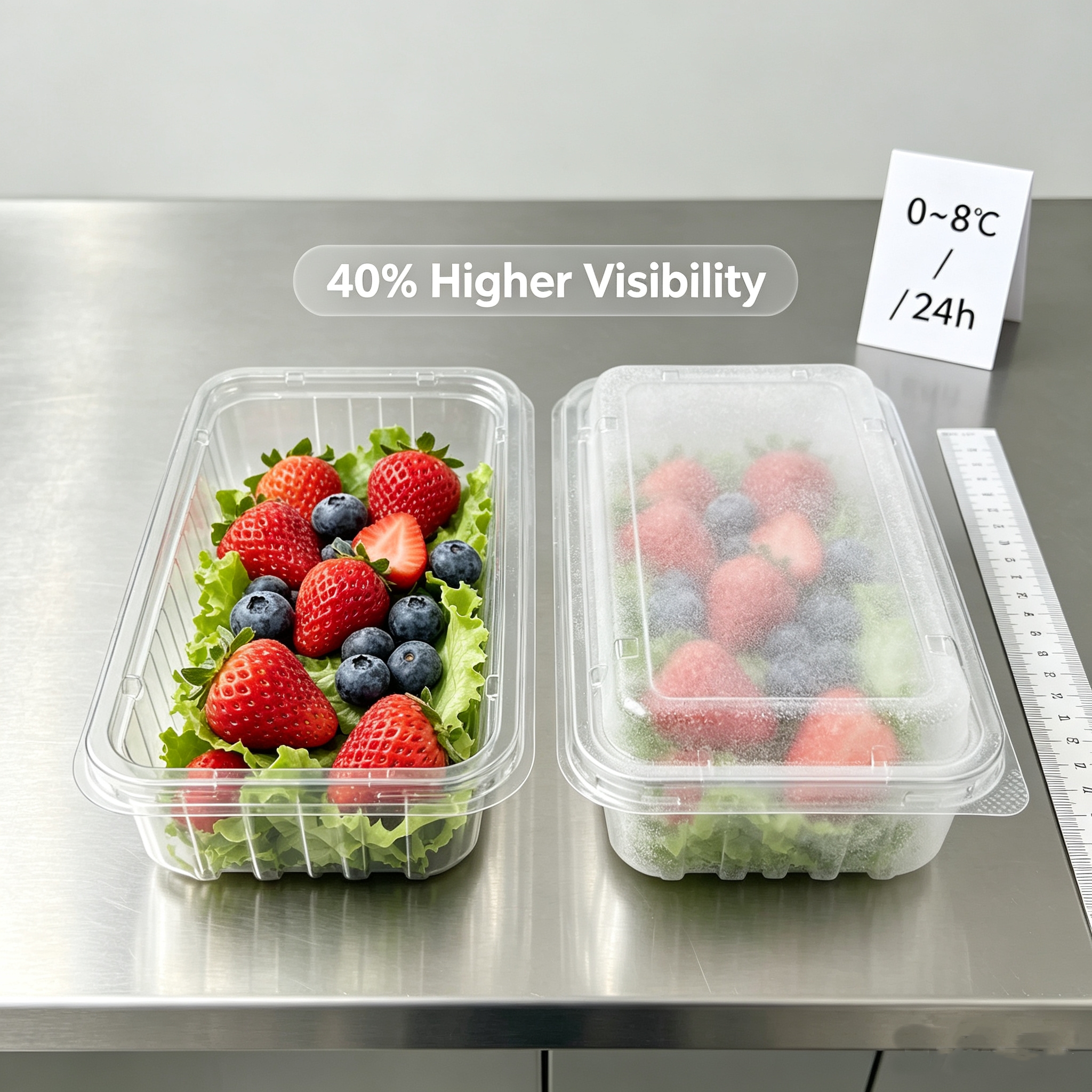
Anti-fog treatment versus untreated PET under cold-storage display conditions.
On temperature behaviour, compared with blister packaging that receives no low-temperature or heat-resistant treatment, the container maintains stable performance under both freezing and heating conditions with less deformation and cracking. It resists a temperature range from −18°C to 120°C, with heat deformation rate reduced by 38% and low-temperature cracking rate reduced by 32%. This suits frozen food storage, microwave heating, quick-freezing processing, cold transportation and ready-to-eat meals. The trade-off is a slightly higher material cost, offset by fewer packaging failures during freezing and heating and less material switching and logistics waste across temperature scenarios.
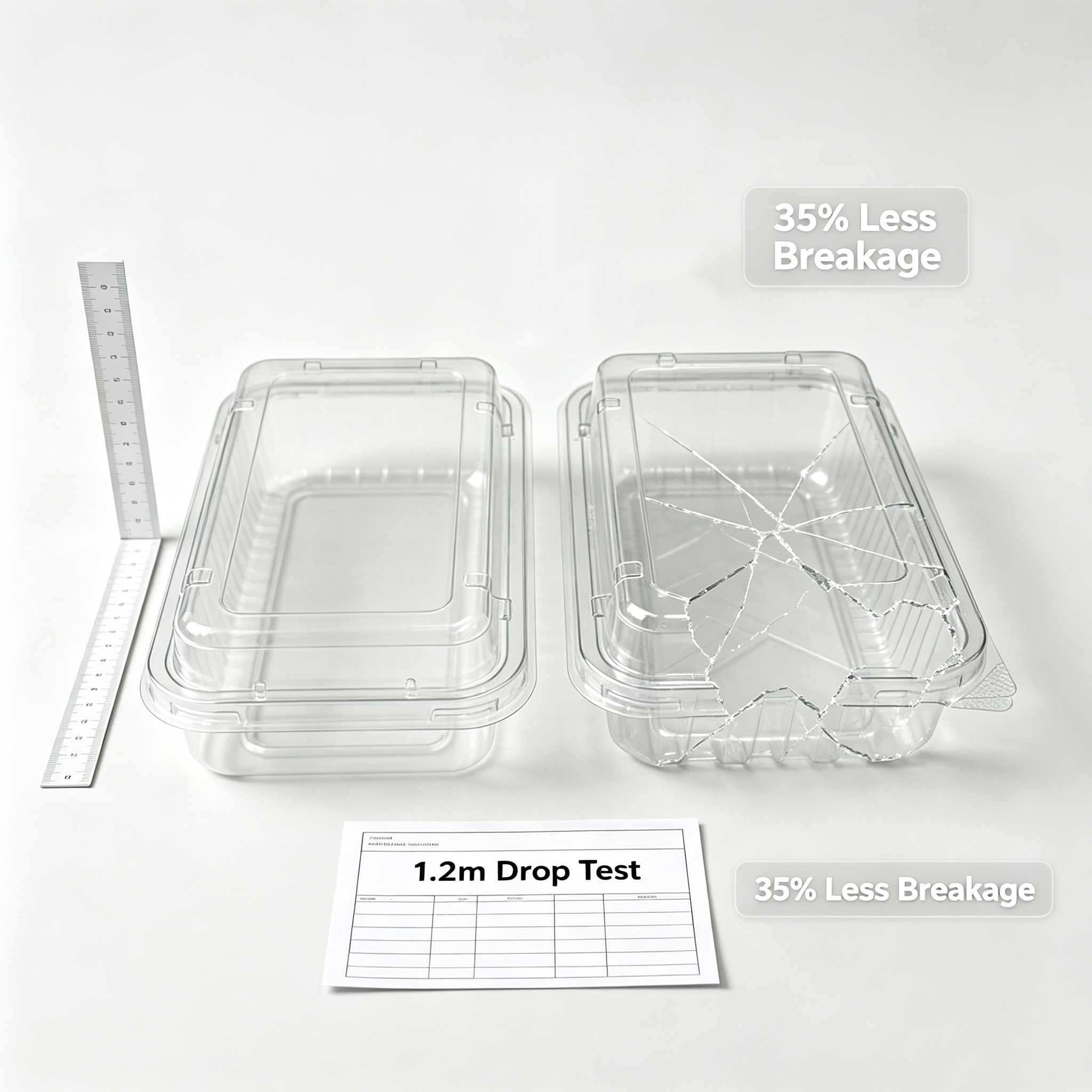
Reinforced PET versus ordinary thin-wall PET: reduced breakage under impact.
On mechanical protection, compared with ordinary thin-wall PET blister packaging, the reinforced structure delivers better drop resistance and is not easy to crack under impact: drop breakage rate is reduced by 35%, and the container can withstand a 1.2 m vertical drop without rupture. That matters most for transit and automated handling, where a lower damage rate reduces repeated repacking. And on sealing, compared with a competitor's blister box, CHUAN HE's containers block the ingress of air and moisture and achieve a leak-proof seal once closed: sealing tightness is increased by 32% and food spoilage rate is reduced by 26%, with a uniform sealing edge that stays stable on automatic packaging assembly lines.
Material-level protection complements the format design. Compared with ordinary disposable plastic food containers, the packaging uses food-grade raw material with good toughness and anti-breakage behaviour: it is 100% compliant with FDA food contact requirements and delivers 30% higher impact resistance. It is 5% higher in cost than low-grade containers but remains competitive among food-grade packaging, needs no special storage condition, stacks to save warehouse space, and its lightweight design reduces logistics transportation cost.
Step-by-Step: Matching a PET Format to a Fresh Food Case
Matching is a sequence, not a single choice. Working through the six steps below in order prevents the common error of buying a format on price and then discovering it fails on sealing, stacking or compliance.
Step 1 — Define the physical case, not the product category
Start from how the product behaves: is it soft and crushable, rigid and irregular, wet or dry, single-unit or compartmented? Cherry tomatoes and berries sit in the same retail aisle as whole dry fruit, but the first needs venting and gentle containment while the second needs anti-crush reinforcement. This step decides the format family: container, tray or salad container.
Step 2 — Match the temperature zone
Map the real temperature path: ambient packing, chilled transport, refrigerated display, freezing, or microwave reheating. Formats intended across freezing and heating should be specified against a stated band such as −18°C to 120°C rather than assumed. Where the case stays in refrigerated display, confirm that the model is refrigerator safe.
Step 3 — Match the presentation requirement
If the sale depends on seeing the product, the body must stay clear in cold storage. Anti-fog treatment maintains a clear appearance under a 0–8°C environment and lifts visibility retention by 40%. If the case does not require transparency, an untreated format may be adequate.
Step 4 — Match sealing and line compatibility
For meat, poultry, produce and ready meals, confirm MAP line compatibility before tooling. Both the HB-MG08 OZ and the HB-T9333 tray are compatible with MAP modified atmosphere packaging production lines. Where the seal is the protection, verify the leak-proof seal behaviour and the sealing tightness figure against the pack's spoilage tolerance.
Step 5 — Match stacking, transit and handling
Stackable design saves warehouse and retail display space, but it must survive the actual load. Check the stated drop performance (−35% breakage, 1.2 m vertical drop) against your own handling profile, and confirm the rigid structure is enough to reduce goods damage during transit.
Step 6 — Confirm compliance, customization and commercial terms
Close with the compliance file and the commercial envelope. Certification coverage and supply-chain controls should be verified before the first production run, and custom requirements should be agreed at the same time as price and lead time.
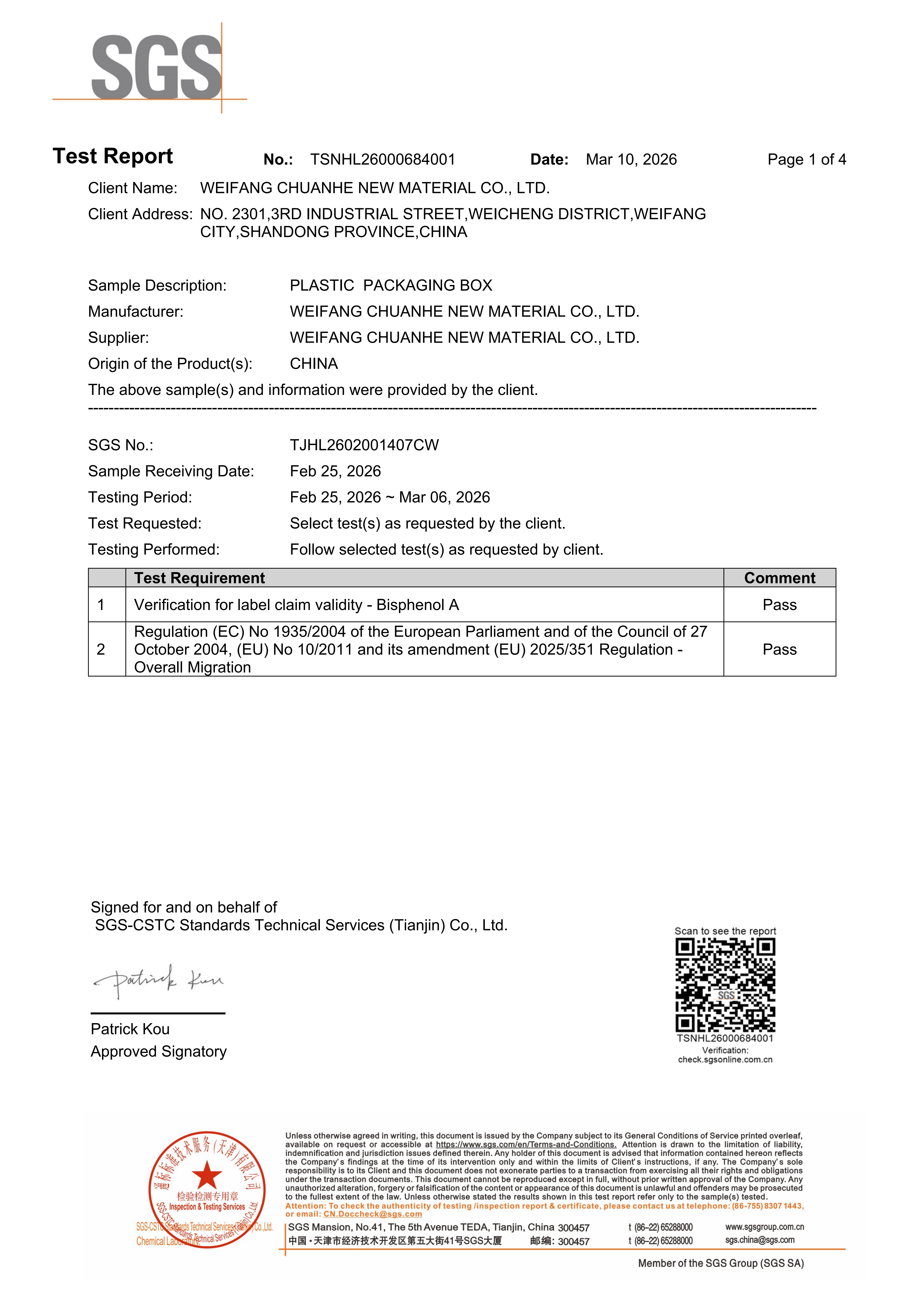
Compliance documentation is part of the format package, not an afterthought.
Application Cases by Buyer Type
The same four format families reappear across very different buyers, but each buyer weights the selection criteria differently.
Produce wholesalers and agricultural exporters
Volume, stacking and transit survival dominate. These buyers are the named intended users of the HB-T9333 tray, alongside supermarket chains, and are the audience the produce packaging range is designed around. Clear stackable containers with vent holes support harvest sorting and retail display, and reinforced structure reduces the repackaging that eats into margin.
Supermarket chains and food retailers
Presentation and shelf life dominate. Retail display depends on a clear transparent tray with excellent visual effect, and anti-fog performance keeps the product readable in the chiller. This is also the group where tamper evidence at delivery points reduces repeated inspection.
Bakeries and food retailers
Bakery is one of the two main product lines CHUAN HE manufactures, alongside fruit and vegetable packaging, and the tray platform carries it: trays packaging with multiple sizes for produce, bakery, meat, poultry and ready meals, a rigid structure that reduces goods damage during transit, and a clear body for counter or shelf presentation.
Meat, poultry and ready-meal producers
MAP compatibility, sealing and temperature range dominate. Typical application scenarios include meat packaging, MAP packaging, produce, bakery, poultry and ready meals packaging. For ready-to-eat formats, the tamper-evident option adds a delivery-integrity check without extra accessories.
Salad and deli operations
Compartment serving and refrigerated display dominate. Models HB1720, 6668 and HB5053 are designed for salads and compartment serving, using the same rigid, clear, stackable construction as the tray range.
E-commerce fresh brands
Transit protection and unboxing integrity dominate. These buyers need stackable, impact-resistant formats that arrive undamaged, and they are explicitly served by the custom packaging offering — e-commerce brands seeking custom packaging are named among the target users, alongside bakeries, food retailers and agricultural exporters.
Comparison Table: Matching Formats to Fresh Food Cases
| Format family | Typical models | Best fresh-food case | Key functional attributes | Compliance & customization |
|---|---|---|---|---|
| Clear stackable fruit & vegetable containers | HB-SG300ML, HB-7001, HB-SG1000ML | Produce storage, refrigerator use, harvest sorting, retail display, cherry tomato and berry clamshell | Clear transparent body, stackable design, vent holes for freshness, some models refrigerator safe | Food-grade BPA-free PET; meets food contact safety standards; custom size, color and logo printing available |
| Compartment & produce trays | HB-MG08 OZ, HB-MG24 OZ, HB-MG40 OZ, HB-T9333, HB-T9576, WSF-01, HB-3066 | Meat packaging, MAP packaging, produce, bakery, poultry, ready meals | Rigid sturdy structure, stackable, compatible with MAP modified atmosphere packaging production lines, clear transparent tray for retail display | Food-grade BPA-free PET; custom shape, color, embossing & logo printing available (HB-T9333) |
| Salad containers | HB1720, 6668, HB5053 | Prepared salads and compartment serving | Rigid, clear, stackable construction suited to refrigerated display and portion service | Food-grade material; food contact safety standards; custom size, color and logo printing available |
| Tamper-evident containers | Anti-tamper locking structure | Ready-to-eat meals, fresh produce, retail kits, sealed logistics | One-time opening only; subsequent opening causes irreversible damage; clear locking structure supports manual or automated sealing | No extra accessories required; slightly higher cost, lower tampering-related return risk |
| Performance behaviour | Compared with | Stated difference | Best applied to |
|---|---|---|---|
| Anti-fog visibility | PET containers without anti-fog treatment | Visibility retention up 40%; clear appearance maintained under 0–8°C | Fresh fruit, ready meals, seafood, cold chain, supermarket retail display |
| Temperature stability | Blister packaging without low-temperature and heat-resistant treatment | −18°C to 120°C; heat deformation −38%; low-temperature cracking −32% | Frozen storage, microwave heating, quick-freezing, cold transportation, ready-to-eat meals |
| Drop resistance | Ordinary thin-wall PET blister packaging | Drop breakage rate −35%; 1.2 m vertical drop without rupture | Transit and automated handling of stackable containers and trays |
| Sealing tightness | Competitor's blister box | Sealing tightness +32%; food spoilage rate −26% | Fresh produce, baked food, seafood, cold-chain circulation |
| Tamper evidence | Packaging without tamper-evident locking design | One-time opening; irreversible damage on reopening | Ready-to-eat meals, fresh produce, pharmaceuticals, retail kits, sealed logistics |
Frequently Asked Questions
What food-contact compliance should a fresh produce packaging supplier meet for EU retailers?
EU Regulation (EC) No 1935/2004 sets the framework for all food contact materials, requiring that they do not release constituents into food at levels harmful to human health, while EU Regulation (EU) No 10/2011 specifically governs plastic materials and articles intended to come into contact with food, including PET and PP containers. CHUAN HE holds quality management system certifications including CE, BRC, FDA, EU and SGS, and manages compliance risk through EU-approved raw materials, migration and physical testing, GMP, batch traceability and tracking of regulation updates so that formulations stay aligned with EU 10/2011, PPWR and PFAS limits. In practice, buyers should ask for the declaration of conformity and the relevant migration and physical test records per format, not per supplier.
Can PET containers and trays be customized to a specific fresh food case?
Yes. Factory direct supply is available with custom size, color and logo printing options, and small and bulk wholesale orders are both supported. The HB-T9333 tray specifically supports custom shape, color, embossing and logo printing, and the HB-MG08 OZ tray is produced in a range of sizes across produce, bakery, meat, poultry and ready meals. Because CHUAN HE operates an in-house mold workshop alongside 4 PET sheet extrusion lines and 2 PP sheet extrusion lines, customization and tooling are handled in the same production flow rather than outsourced.
What are the minimum order quantity and payment terms?
The stated minimum order quantity is 10,000 units. Delivery terms are FOB, CIF and DDP, the acceptance criterion is a pre-shipment test, and payment terms cover T/T, L/C, D/P D/A, MoneyGram, PayPal, Western Union and Cash. Buyers comparing quotations across formats should apply the same commercial terms to each format so the comparison stays valid.
How can a buyer validate a format before committing to a full production run?
Validation runs through the stated pre-shipment test acceptance criterion, supported by online quality inspection and finished product sampling test during production. Food-grade raw material inspection and production hygiene control are applied at the input stage to prevent contamination, and quality assurance procedures include migration and physical testing, regular third-party testing and batch tracing for contamination prevention. A buyer evaluating several formats should test the cold-chain behaviour of each one, since the anti-fog, temperature and sealing figures differ by treatment and by format.
How should a buyer choose a long-term fresh produce packaging supplier for EU retailers?
Look at four things: whether the compliance record is documented at batch level, whether the format range can cover every case in the portfolio rather than just the largest one, whether supply has already been sustained at volume, and whether the supplier can absorb specification changes without re-tooling delays. On supply continuity, CHUAN HE has supplied food factories, large chain supermarkets, packaging wholesalers and packaging manufacturers in the United Arab Emirates and Saudi Arabia for over three years at a monthly volume of 250,000 pieces, covering farm fresh fruit and vegetable packaging, cherry tomato and berry clamshell packaging, harvest sorting and retail display. Supply chain risk is managed by auditing suppliers, using only EU-approved raw materials, verifying supplier certificates and maintaining batch tracing for raw material accountability. Buyers ready to move from shortlist to trial can request a sample set matched to their own fresh-food case.
Conclusion: Match the Case, Then the Format
Fresh food packaging fails most often for a simple reason: the format is chosen before the case is defined. Working in the other direction — physical behaviour, temperature path, presentation requirement, sealing, stacking and compliance — reduces the specification to a small number of defensible options. Clear stackable fruit and vegetable containers cover produce storage, harvest sorting and refrigerated display; compartment and produce trays cover meat, MAP, bakery, poultry and ready meals on MAP-compatible lines; salad containers cover prepared salads and compartment serving; and the tamper-evident option covers any case where delivery integrity has to be visible at a glance.
Every one of those formats sits on the same foundation: food-grade BPA-free PET, clear transparent bodies, stackable design and food contact safety standards, backed by CE, BRC, FDA, EU and SGS quality management system certifications and a supply chain built on approved raw materials, batch traceability and third-party testing. Matching the format to the case is the part buyers control; keeping that match stable across every subsequent order is the part the supplier has to prove.
Request a format match for your fresh-food case
Send us your product type, temperature path and display requirement, and CHUAN HE will map it to the relevant container, tray or salad format — with sample options, tooling feasibility and MOQ guidance. The minimum order quantity is 10,000 units, with FOB, CIF and DDP delivery terms available.
Email: chuanhe@newplasticbox.com | Tel / WhatsApp: +86 134-5566-2777
Website: www.newplasticbox.com | Download the product catalogue: CHUAN HE packaging catalogue (PDF)
Weifang Chuanhe New Material Co., Ltd. · No. 2301 Industrial Third Street, Weicheng Economic Development Zone, Weifang City, Shandong Province, China
Stackable formats reduce warehouse space and logistics cost across the cold chain.
Have Questions or Need More Details?
Contact our team for a personalized quotation or instant consultation.
Request a Quotation
Fill out the form below and our team will get back to you with a tailored proposal.
WhatsApp Direct Chat
Prefer to chat in real-time? Message us on WhatsApp for instant assistance & quick answers.
- Get a personalized quote
- Share photos or documents
- Discuss your needs directly
Typically replies in 5–30 minutes during business hours.