
Fruit & Vegetable Packaging: Checking PET Tray Dimensions & Material Grade
Fruit & Vegetable Packaging: Checking PET Tray Dimensions & Material Grade
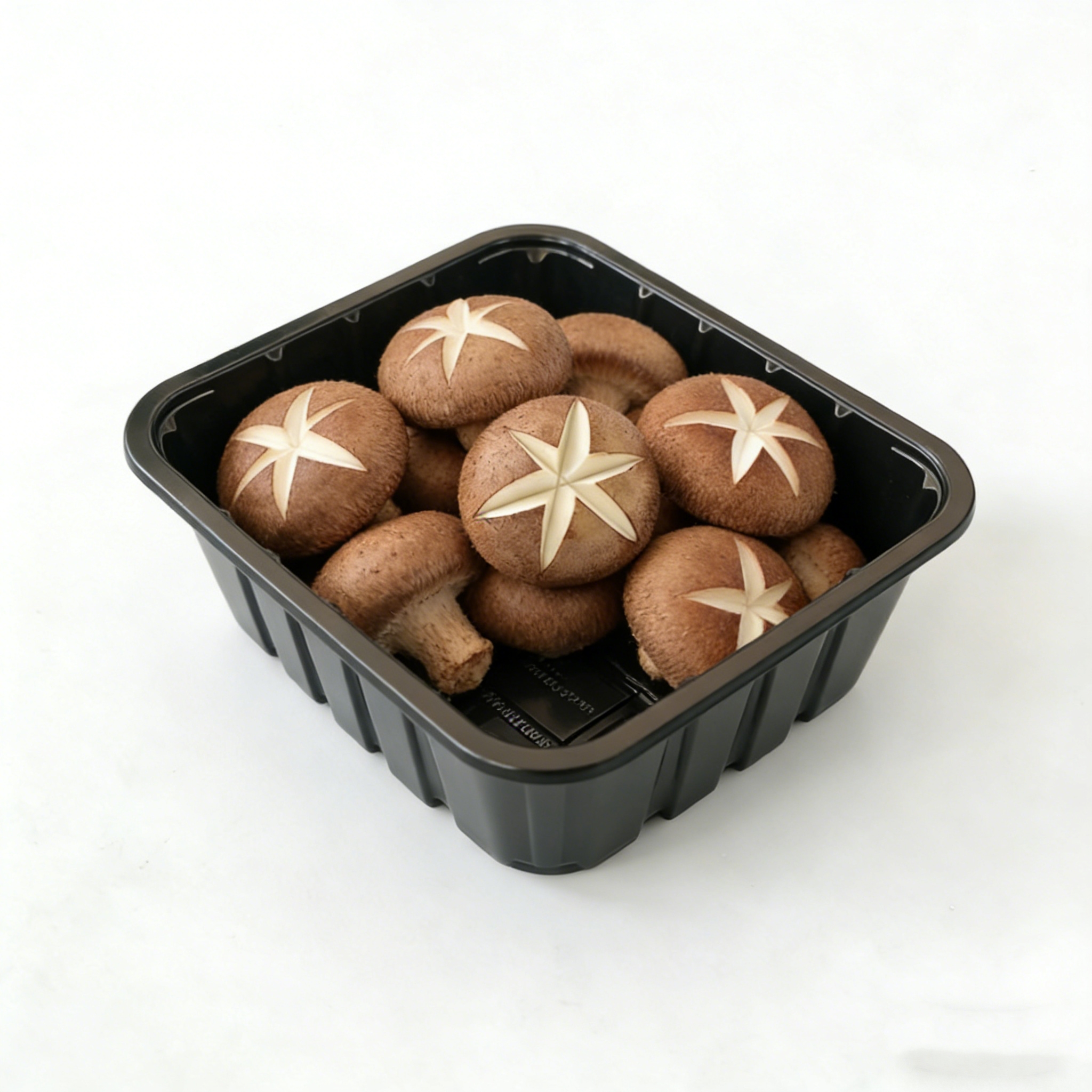
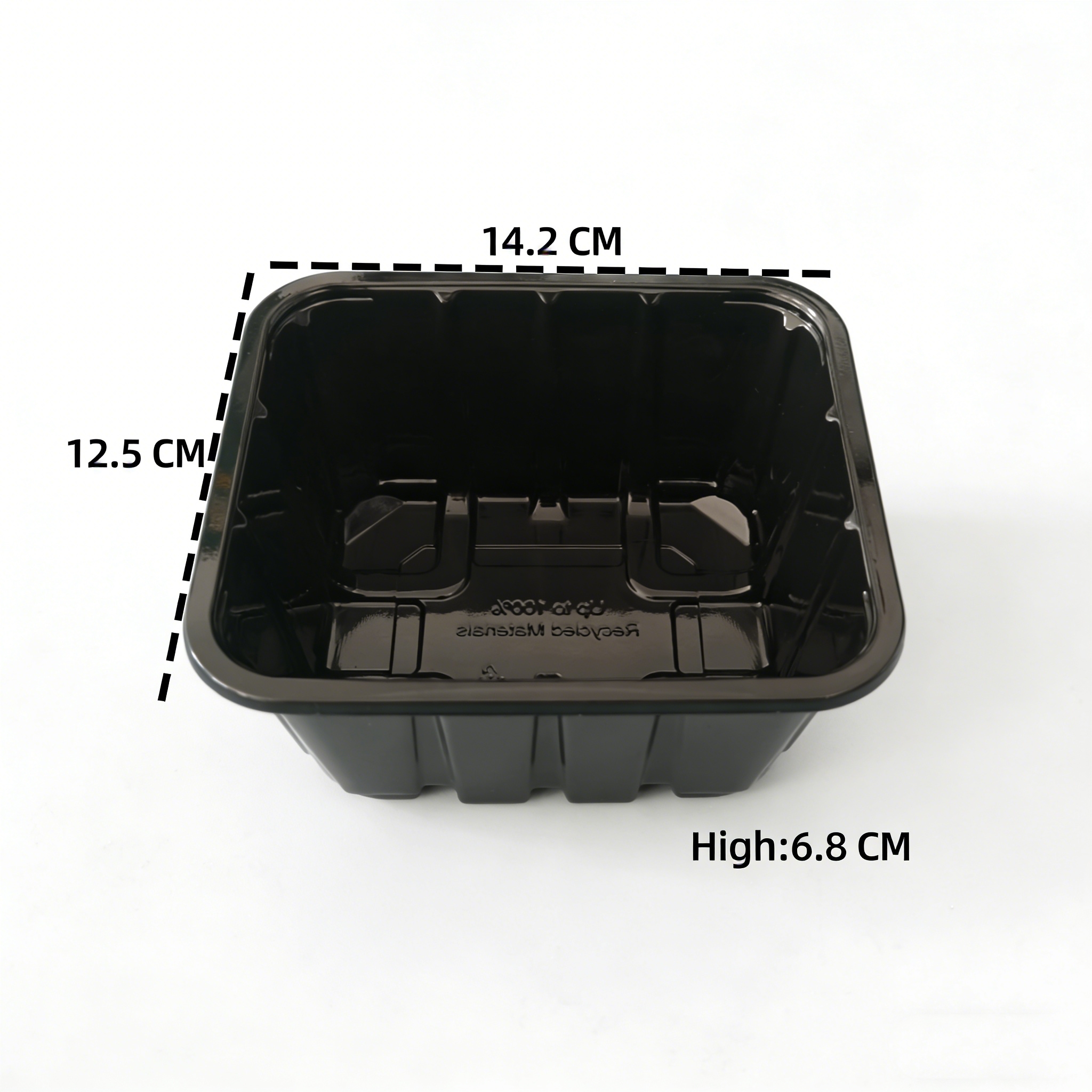
PET tray model HB-MG08 OZ, published at 14.2 × 12.5 × 6.8 cm, part of a custom blister tray family used for produce, bakery, meat and ready-meal packaging.
A PET produce tray is bought twice. The first time, it is bought on a specification sheet that says something like “14.2 × 12.5 × 6.8 cm, PET, food grade.” The second time, it is bought on a supermarket shelf, where that tray either fits the case, stacks in the chiller and reads clearly through a clear body — or it does not.
When the two purchases disagree, the cost lands on the buyer: re-cut inserts, repacked cases, a salad container that will not stack, or a deli display that has to be rebuilt around a tray that is two millimetres too tall. In fruit & vegetable packaging, dimension accuracy and material grade are the two claims that carry the most downstream risk, and they are also the two claims most often accepted without verification.
This guide sets out how a buyer can verify both claims before a purchase order is placed. It uses published product data from Weifang Chuanhe New Material Co., Ltd. (CHUAN HE) — a manufacturer established in 2013 in Weifang, China, adjacent to Qingdao Port, that specialises in the design and customised production of PET and PP thermoformed packaging containers for baking packaging and fruit and vegetable packaging — as a worked example of how spec-sheet data should be read.
Problem Definition: Why Dimension and Grade Claims Drift
Dimension claims drift for two structural reasons, and neither of them requires anyone to be dishonest.
First, nominal and finished dimensions are not the same thing. A thermoformed tray is drawn from a sheet over a mould. The mould has one set of dimensions; the finished part, after shrinkage and trimming, has another. A buyer who compares a mould drawing with a published finished-part figure will find a difference that has nothing to do with quality control. The only figure that matters for shelf fit is the finished external dimension of the delivered part.
Second, closely related products share near-identical footprints. Within the CHUAN HE tray and container ranges, several models sit inside the same 14 cm band:
- HB-MG08 OZ — PET tray, 14.2 × 12.5 × 6.8 cm, in the custom blister tray family
- HB-8OZ-235 — PET fruit & vegetable container, 14.3 × 12.5 × 6 cm
- HB-16OZ — PET tamper-evident container, 14 × 11.6 × 6.2 cm
- HB002-63 — PET tamper-evident container, 14.6 × 12.3 × 6.7 cm
- HB-3066 — PET tray, 14.4 × 12.2 × 4.7 cm
Length varies by only 0.6 cm across that group, but finished height ranges from 4.7 cm to 6.8 cm. A buyer who approves “a 14 cm tray” rather than a model number has not specified anything. Height is what determines whether the lid closes under a case lid, whether the tray clears a shelf lip, and whether a MAP line can seal it.
Material grade drifts differently. “Clear plastic” covers PET and PP, which behave differently in thermoforming, in low-temperature cold chain, and in visual clarity. A tray quoted as food grade may be food grade in the sense that it is intended for food contact, or food grade in the sense that documentation exists. Those are not equivalent positions for a supermarket chain that has to defend its own compliance file.
The practical consequence is that a supplier evaluation built on adjectives — clear, sturdy, stackable, food grade — cannot be audited. An evaluation built on model numbers, published dimensions and material designations can be.
Industry Background: A Larger Category Under Tighter Constraints
The pressure to verify rather than assume is coming from the size and regulation of the category itself. The global fresh food packaging market reached USD 134.60 billion in 2024 and is projected to reach USD 240.50 billion by 2035 (Spherical Insights & Consulting). The narrower global produce packaging market, specific to fruits and vegetables, was valued at approximately USD 38.08 billion in 2024 (Market Research Future). Within Europe, the fresh food packaging market stood at USD 15.2 billion in 2024, with a projected CAGR of 4.5% through 2033 (Market Research Future). The thermoformed plastics segment used for food packaging is expected to grow at a CAGR of 4.9%, reaching USD 20.66 billion by 2030 (Grand View Research).
Regulation is tightening in parallel. EU Regulation (EC) No 1935/2004 provides the framework for all food contact materials, ensuring they do not release constituents into food at levels harmful to human health (European Commission). EU Regulation (EU) No 10/2011 specifically governs plastic materials and articles intended to come into contact with food, including PET and PP containers (EUR-Lex). Looking further ahead, from 2030 the EU Packaging and Packaging Waste Regulation (PPWR) will ban single-use plastic packaging for fresh fruit and vegetables under 1.5 kg (European Commission / Earth.Org).
The category is also structurally mixed. Alongside specialist thermoformers, it includes large multinational suppliers such as Amcor PLC, Berry Global Group, Sealed Air Corp, Mondi Group and Smurfit Kappa (Mordor Intelligence). For a buyer, that mix means supplier size is a weak signal. What separates suppliers is whether the specific claim on the specific model can be evidenced — and that is a question a buyer can answer directly.
Detailed Solution: The Two Claims That Decide the Programme
Dimension accuracy: what “14.2 × 12.5 × 6.8 cm” does and does not tell you
A published dimension is a finished-part envelope: external length, external width and external height of the delivered item. For HB-MG08 OZ, that envelope is 14.2 × 12.5 × 6.8 cm. The same specification states the actions the tray is designed for: it is classified as a produce tray and bakery tray, is made of PET, meets food contact safety standards with food grade BPA-free plastic, has a rigid sturdy structure, a clear transparent body and a stackable design, and is compatible with MAP modified atmosphere packaging lines. It is designed for packaging produce, bakery, meat, poultry and ready meals, and is intended for produce wholesalers, supermarket chains, agricultural exporters, bakeries and food retailers, and e-commerce brands.
What the envelope does not tell you, and what a buyer must confirm separately, is nesting height when stacked, base footprint flatness on a shelf, and lid engagement once the tray is loaded. These are not marketing questions. They decide whether a supermarket chain can place the tray in an existing display unit without redesigning the fixture.
Mass stock and custom logo availability on the PET tray range — relevant when a supermarket chain needs brandable trays at volume.
Material grade: PET, PP and the food-contact statement
The material designation is the second claim to verify, and it should be read per model rather than per catalogue. In the CHUAN HE range, most listed trays and containers are PET — including HB-MG08 OZ, HB-MG24 OZ, HB-MG40 OZ, HB-T9576, WSF-01, HB-3066, HB-7001, HB-SG250ML, HB-SG300ML, HB-SG500ML and HB-SG1000ML, plus the salad container and tamper-evident families. PP appears on specific models: HB-75-28(PP) at 16.8 × 11.4 × 3 cm and HB-221360(PP) at 22.2 × 13 × 6 cm.
That distinction matters because PET is selected for high transparency and clear visibility of contents, which is why the majority of the retail-facing produce trays and salad containers in the range are PET. Where a buyer needs clarity as a merchandising feature — a cherry tomato or berry punnet, a salad box, a transparent supermarket display tray — the material is not an incidental detail but part of the commercial function.
The food-contact statement should then be matched against documented certification. CHUAN HE states certification across CE, BRC, FDA, EU and SGS quality management systems. More specifically, its plastic packaging is certified to BRCGS under the Global Standard for Packaging Materials, issued by SGS with certification number CN26/00005423, applicable to the NA, EU, ME, SEA and LATAM markets. A certification number and issuing body are verifiable; the phrase “food grade” on its own is not.
Stackability and clear bodies: the shelf-integration test
Stackability is where dimension claims and material claims meet. The salad container family illustrates the point. HB5053 measures 15.2 × 10.2 × 5.3 cm and has a stackable structure to save storage space, an optional compartment design and a leakproof airtight lid, in food-grade BPA-free plastic. HB1720 measures 18.5 × 18.5 × 6 cm. HB7047 measures 15.6 × 11.7 × 4.5 cm with the same leakproof, airtight lid, stackable structure and optional compartment. HB5240 is 17 × 11.5 × 3.7 cm and HB5224 is 17.1 × 12.3 × 5.6 cm, both with clear transparent design, leakproof and airtight lids, and multiple size options with custom logo printing.
These five models share the same functional claims but not the same footprint. For a supermarket chain running prepared salads, the choice among them is a shelf-depth decision first and a packaging decision second. A clear body that shows contents is only useful if the box also fits the fixture depth and stacks without leaning — which is why stackability should be tested with the container loaded, not empty.
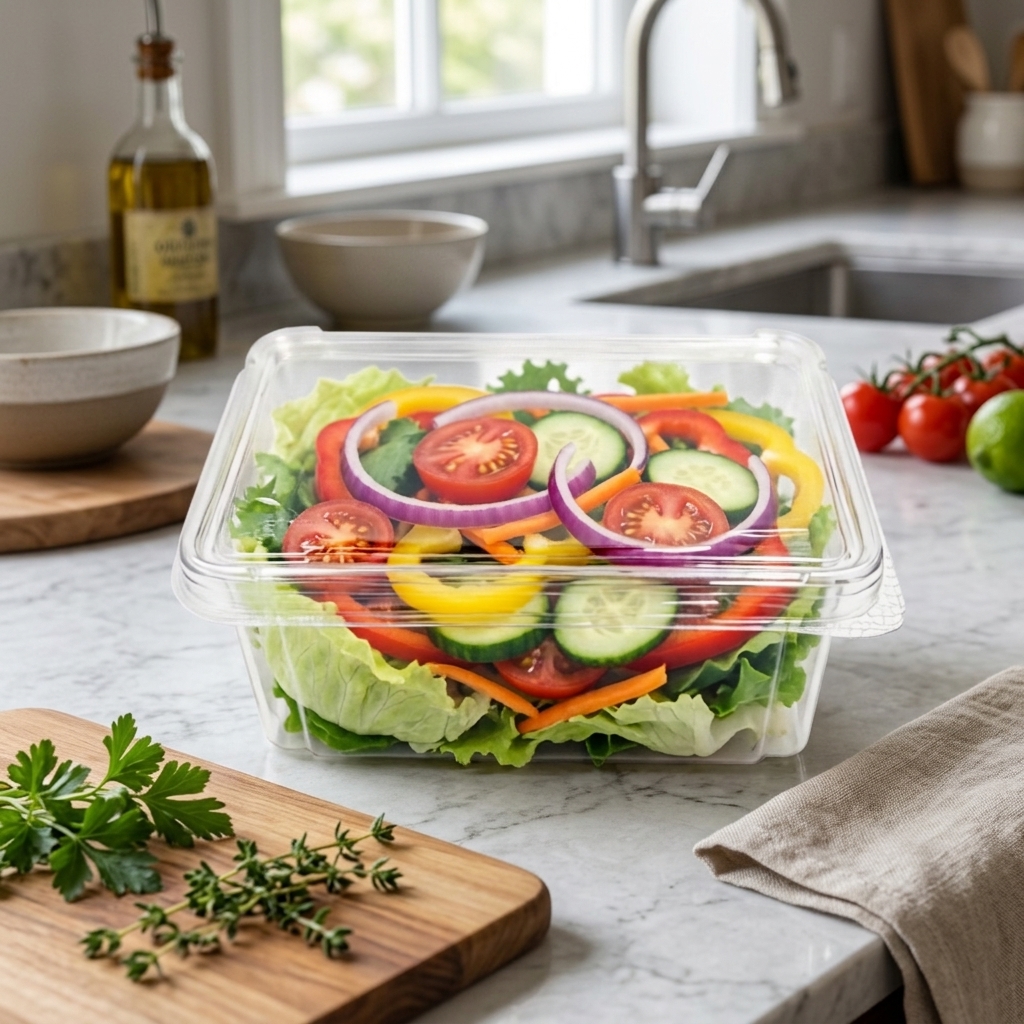
Salad containers combine a clear transparent body with a stackable structure and a leakproof airtight lid — three claims that must hold at the same time.
Why the supplier’s tooling and extrusion capability back the claims
A supplier can publish an accurate dimension and still fail to reproduce it at volume. The capability that supports dimension consistency is upstream of the thermoforming line. CHUAN HE operates 4 PET sheet extrusion lines and 2 PP sheet extrusion lines, together with an in-house mould workshop, 20 fully automatic thermoforming machines and 20 standard thermoforming machines, including 4 advanced Kiefel machines imported from Germany. Annual production capacity reaches 54,000 tons, and the R&D team consists of 5 engineers. The facility covers 62,000 m², employs 51–100 staff, and exports 100% of sales to the EU, US, North America, Latin America and the Middle East.
In-house sheet extrusion and mould making are not background trivia. They are the reason a dimension can be held: sheet thickness variation and mould condition are the two most common causes of a finished part drifting outside its stated envelope. A buyer evaluating any PET produce supplier should ask the same question — who controls the sheet and who controls the mould?
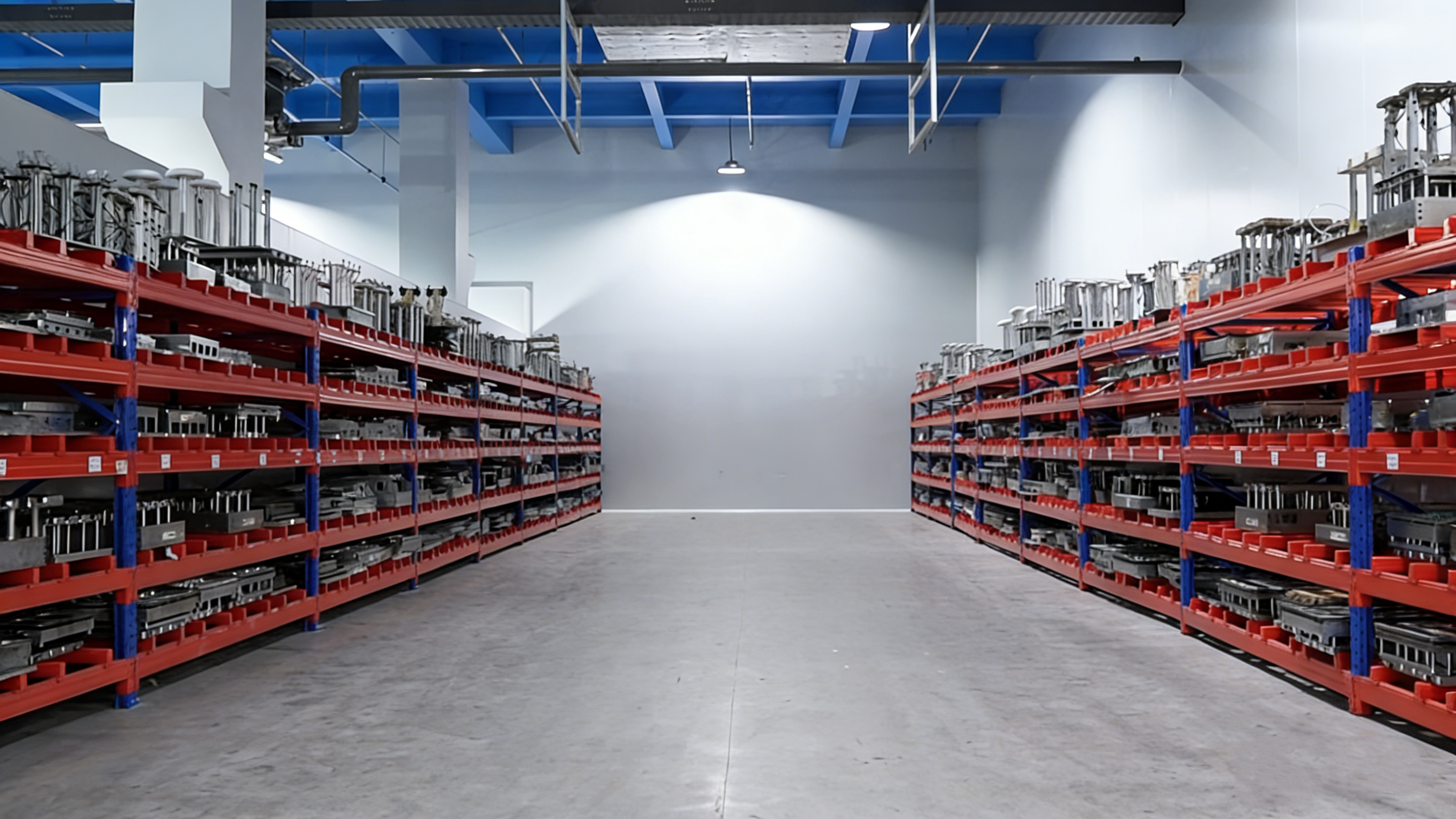
An in-house mould workshop is the mechanism behind custom blister tray tooling and repeatable finished dimensions.
Step-by-Step Breakdown: A Seven-Step Vendor Verification Protocol
The following sequence can be run on any PET produce packaging supplier, and it produces a file rather than an impression.
Step 1 — Desk-check the published dimension against your case and shelf. Take the finished external figure, not a mould drawing. Confirm length, width and height against the internal dimensions of your transport case, your display fixture and your MAP line tooling. A 0.5 cm difference in height is a case-loading difference.
Step 2 — Match the model number, not the shape. When two trays look alike, the model number is the specification. HB-MG08 OZ at 14.2 × 12.5 × 6.8 cm and HB-8OZ-235 at 14.3 × 12.5 × 6 cm differ by 0.1 cm in length and 0.8 cm in height while belonging to different product families — one a tray, one a fruit and vegetable container. Approving “the 14 cm one” is not an approval.
Step 3 — Confirm the material designation per model. Ask for PET or PP explicitly for each model number on the order. Note where PP is used, as with HB-75-28(PP) and HB-221360(PP), and confirm that the material choice matches your clarity and temperature requirements rather than assuming the catalogue default.
Step 4 — Request food-contact and certification evidence. Ask for the framework the material is assessed against — for EU-bound produce, Regulation (EC) No 1935/2004 as the general framework and Regulation (EU) No 10/2011 for plastics — and for the certificate number and issuing body. A named certification is auditable; a logo is not.
Step 5 — Measure a physical trial order. Measure the finished part, not a sample moulding. CHUAN HE supports small trial orders alongside bulk wholesale, which allows a buyer to measure delivered trays at the stated envelope before committing to volume.
Step 6 — Stack and load the containers. Test the salad and produce containers with contents, at chilled temperature. Stackability claims are only meaningful under load; a clear body is only meaningful if the stack stays straight on the shelf.
Step 7 — Verify the production control behind the dimension. Confirm who extrudes the sheet, who holds the mould and how the thermoforming lines are maintained. In-house extrusion plus in-house mould making is a materially different control position from outsourced sheet and third-party tooling.
One test that catches most dimension failures: order the tray and the container that sit closest in size within the same family, measure both, and confirm they are not interchangeable. If a supplier cannot explain why 14.2 × 12.5 × 6.8 cm and 14.3 × 12.5 × 6 cm are different products, the specification is being managed by shape rather than by data.
Use Cases: Where the Verification Protocol Pays Off
Supermarket chain shelf integration
Supermarket chains are the most dimension-sensitive buyer group, because a tray change can require fixture changes across a store estate. The CHUAN HE tray and container ranges are explicitly intended for supermarket chains, produce wholesalers, agricultural exporters, bakeries and food retailers, and e-commerce brands. In one Canadian project, food plastic containers are used for supermarket fresh produce display, cold chain storage and food packaging transportation, at a monthly order of 300,000 pieces, with food-grade PP material, a durable stackable design, custom size support and suitability for low-temperature environments; the cooperation has lasted over five years with stable quality and high delivery reliability.
Prepared salad and deli programmes
Prepared salads need three properties simultaneously: a clear body, an airtight leakproof lid to prevent dressing spilling during delivery, and a stackable structure. The salad container range — 15.2 × 10.2 × 5.3 cm, 18.5 × 18.5 × 6 cm, 15.6 × 11.7 × 4.5 cm, 17 × 11.5 × 3.7 cm and 17.1 × 12.3 × 5.6 cm — gives a buyer five footprints to test against a single fixture before selecting.
Berry, cherry tomato and punnet formats
Small-format produce places the highest premium on clarity, since the consumer buys what is visible. Fruit and vegetable containers such as HB-SG250ML (13.5 × 11.5 × 6.5 cm), HB-SG300ML (17.5 × 13.5 × 6 cm), HB-SG500ML (17.5 × 13.5 × 7.5 cm), HB-SG1000ML (23 × 17.5 × 9 cm) and HB-7001 (19.5 × 19.5 × 5 cm) are made of PET with a clear transparent body, stackable design and refrigerator-safe construction, with custom size, colour and logo printing available.
Export, cold chain and cross-border supply
For exporters, dimension accuracy is a freight issue as much as a shelf issue: an envelope that is 1 cm taller changes how many units fit a pallet layer. In Southeast Asia, projects across Malaysia, Thailand, Vietnam, Singapore and Indonesia involve monthly orders of 500,000 food plastic containers used for fresh fruit and vegetable packaging, seafood and meat cold chain packaging, food factory processing, supermarket retail display and wholesale distribution, with one case featuring a 12-year cooperation on clear PET clamshell containers that are stackable, food-grade and fitted with vent holes.
Temperature resilience where cold chain and reheating overlap
Where produce packaging shares a line with chilled or reheated food, thermal behaviour becomes part of the material grade question. CHUAN HE reports that, compared with blister packaging without low-temperature and heat-resistant treatment, its blister box maintains stable performance under both freezing and heating conditions with less deformation and cracking, providing a 38% lower heat deformation rate and a 32% lower low-temperature cracking rate. Stable hardness after temperature changes results in fewer broken boxes, which is relevant for frozen food storage, microwave heating, quick-freezing processing, cold transportation and ready-to-eat meals.

Thermoforming capacity across 20 fully automatic and 20 standard machines, including 4 Kiefel machines, supports repeatable finished dimensions at volume.
Comparison Table: Published Dimensions and Material by Model
The table below lists published dimensions and material designations for selected models in the CHUAN HE PET and PP produce packaging range. It is intended as a buyer-side cross-check reference: every figure below is a published product specification, and each row can be verified against the model number on a quotation.
| Model | Product family | Material | Published dimensions |
|---|---|---|---|
| HB-MG08 OZ | Tray / custom blister tray | PET | 14.2 × 12.5 × 6.8 cm |
| HB-8OZ-235 | Fruit & vegetable container | PET | 14.3 × 12.5 × 6 cm |
| HB002-63 | Tamper evident container | PET | 14.6 × 12.3 × 6.7 cm |
| HB-3066 | Tray / custom blister tray | PET | 14.4 × 12.2 × 4.7 cm |
| HB-MG24 OZ | Tray / custom blister tray | PET | 18.6 × 18.6 × 8.9 cm |
| HB-MG40 OZ | Tray / custom blister tray | PET | 28 × 19.4 × 6.8 cm |
| HB-T9576 | Tray | PET | 19.4 × 11.4 × 5.8 cm |
| WSF-01 | Tray | PET | 23.3 × 18 × 5 cm |
| HB-75-28(PP) | Tray | PP | 16.8 × 11.4 × 3 cm |
| HB-221360(PP) | Tray | PP | 22.2 × 13 × 6 cm |
| HB-7001 | Fruit & vegetable container | PET | 19.5 × 19.5 × 5 cm |
| HB-SG500ML | Fruit & vegetable container | PET | 17.5 × 13.5 × 7.5 cm |
| HB-SG1000ML | Fruit & vegetable container | PET | 23 × 17.5 × 9 cm |
| HB5053 | Salad container | PET | 15.2 × 10.2 × 5.3 cm |
| HB1720 | Salad container | PET | 18.5 × 18.5 × 6 cm |
| HB7047 | Salad container | PET | 15.6 × 11.7 × 4.5 cm |
| HB5240 | Salad container | PET | 17 × 11.5 × 3.7 cm |
| HB5224 | Salad container | PET | 17.1 × 12.3 × 5.6 cm |
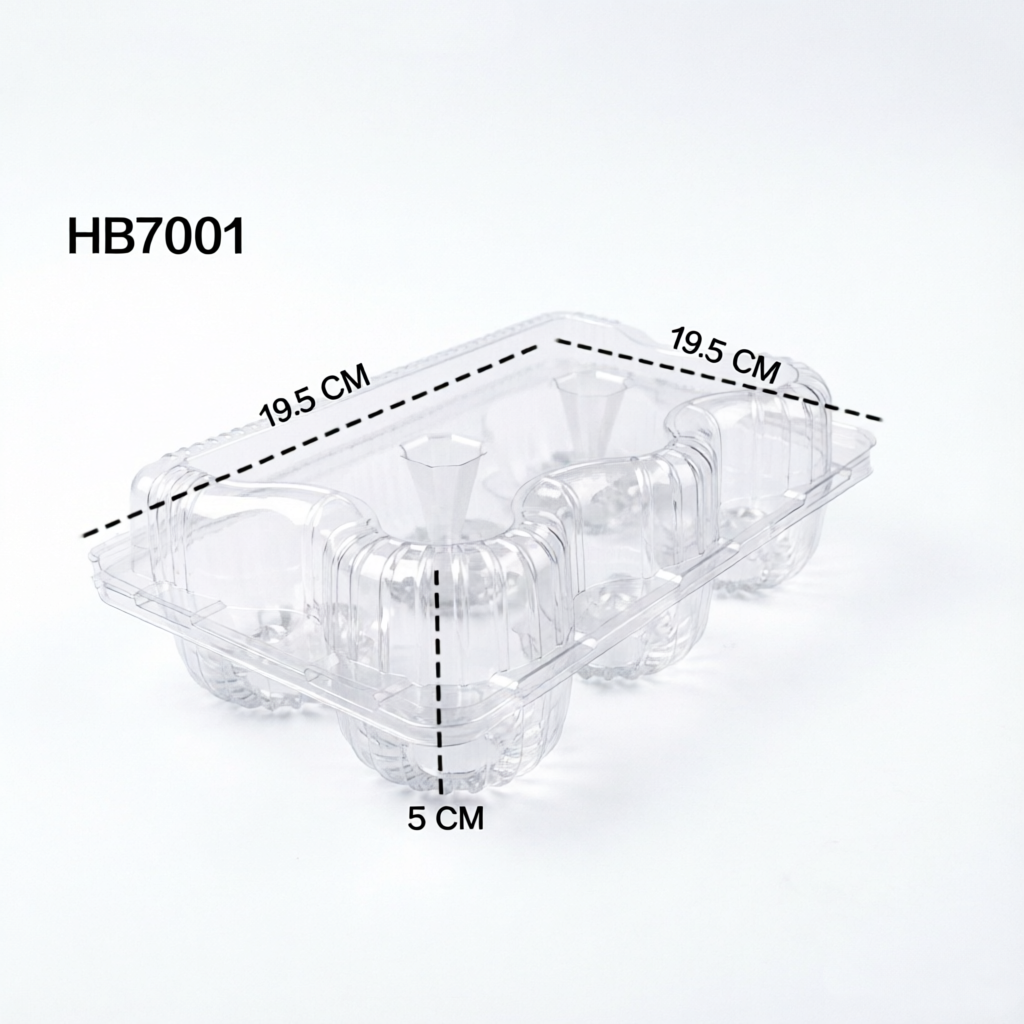
Published dimension references such as this HB-7001 drawing are the figures a buyer should cross-check against case and shelf dimensions.
Frequently Asked Questions
What food-contact compliance evidence should a fruit and vegetable packaging supplier provide?
For EU-bound fresh produce, the relevant framework is EU Regulation (EC) No 1935/2004, which requires food contact materials not to release constituents into food at levels harmful to human health, with Regulation (EU) No 10/2011 governing plastic materials and articles specifically, including PET and PP containers. A buyer should ask for the certification name, the issuing body and the certificate number. CHUAN HE states certification across CE, BRC, FDA, EU and SGS quality management systems, and its plastic packaging is certified to BRCGS under the Global Standard for Packaging Materials, issued by SGS with certification number CN26/00005423, applicable to the NA, EU, ME, SEA and LATAM markets.
How can I confirm that a supplier can actually hold a custom tray dimension at volume?
Look upstream of the thermoforming line. Dimension drift usually originates in sheet thickness variation or mould condition, so the control questions are who extrudes the sheet and who holds the mould. CHUAN HE operates 4 PET sheet extrusion lines and 2 PP sheet extrusion lines plus an in-house mould workshop, alongside 20 fully automatic thermoforming machines and 20 standard thermoforming machines including 4 advanced Kiefel machines, with annual capacity of 54,000 tons and an R&D team of 5 engineers. In-house extrusion and mould making, rather than outsourced sheet and third-party tooling, is the structural reason a published figure such as 14.2 × 12.5 × 6.8 cm for HB-MG08 OZ can be repeated across production runs.
What drives the cost of a custom PET produce tray programme?
Three factors dominate in practice: the material designation per model (PET versus PP), the tooling required for a custom shape, colour, embossing or logo, and the order format. CHUAN HE maintains an in-house mould workshop, which reduces the cost of outsourced raw materials and supports coordinated production and faster delivery, and it operates as a factory direct supplier supporting small trial orders and bulk wholesale. Because the company has developed thousands of moulds, a buyer should ask whether an existing mould can be adapted before assuming a new tool is required — that question typically has more cost impact than any other in the specification stage.
Can we validate dimensions and material before placing a full order?
Yes. The PET tray and container range is offered as factory direct supply with support for small trial orders as well as bulk wholesale orders, and custom size, colour and logo printing are available. A trial order allows a buyer to measure the finished external envelope, stack the salad containers under load, confirm lid engagement and check clarity against a display fixture before committing to production volume. Given that several models sit within 0.6 cm of each other in length, physical measurement of the specific model number is the only reliable validation step.
What affects delivery and lead time for PET produce packaging?
Two structural factors matter most: whether raw material and tooling are controlled in-house, and how close production is to a major export port. CHUAN HE operates sheet extrusion, mould making and thermoforming within a single 62,000 m² facility in Weifang, China, adjacent to Qingdao Port, which supports coordinated production and faster delivery. Export business accounts for 100% of sales, with major markets including the European Union, United States, North America, Latin America and the Middle East. Buyers can review capacity, machine inventory and contact details in the company brochure and request a quotation with target model numbers and volumes.
Conclusion: Verify the Number, Not the Adjective
The difference between a working produce packaging programme and an expensive correction is usually one of two things: a model number instead of a shape, and a certification number instead of a claim. Dimension accuracy is verifiable — measure the finished part, match it to the case and the shelf, and confirm that two trays that look alike are in fact different products. Material grade is verifiable — name the material per model, and pair the food-contact statement with the framework and the certificate behind it.
For buyers working through fruit & vegetable packaging selection at the research stage, the practical starting point is a shortlist of model numbers with published dimensions, read alongside the supplier’s extrusion and mould capability. Weifang Chuanhe New Material Co., Ltd. publishes both, and its range covers PET and PP trays, fruit and vegetable containers, salad containers and tamper-evident formats for supermarket chains, produce wholesalers, agricultural exporters and food retailers.
Next Step: Test the Specification Yourself
If you are evaluating PET trays or containers for a supermarket, wholesale or export programme, request a trial order against the specific model numbers you are considering — for example HB-MG08 OZ at 14.2 × 12.5 × 6.8 cm or HB5053 at 15.2 × 10.2 × 5.3 cm — and measure the finished parts against your own case and shelf dimensions.
Company brochure (view and download): CHUAN HE product catalogue
Website: www.newplasticbox.com
Email: chuanhe@newplasticbox.com
Phone / WhatsApp: +86 134-5566-2777
Weifang Chuanhe New Material Co., Ltd. — No. 2301 Industrial Third Street, Weicheng Economic Development Zone, Weifang City, Shandong Province, China.
Have Questions or Need More Details?
Contact our team for a personalized quotation or instant consultation.
Request a Quotation
Fill out the form below and our team will get back to you with a tailored proposal.
WhatsApp Direct Chat
Prefer to chat in real-time? Message us on WhatsApp for instant assistance & quick answers.
- Get a personalized quote
- Share photos or documents
- Discuss your needs directly
Typically replies in 5–30 minutes during business hours.