
Regional Food-Contact Compliance for PET Produce Trays: A Market-by-Market Guide
The claim “PET, food-grade, BPA-free” travels well between markets. The paperwork behind it does not. A PET produce tray shipped to a German supermarket chain, a Canadian grocery distributor and a Gulf agricultural exporter may come from the same mould, the same resin and the same in-line test regime — yet each destination asks for a different document set, names the material differently, and reaches back into traceability to a different depth. Buyers who treat one certificate pack as a universal passport usually find the gap late: at goods acceptance, or at the importer’s customs desk.
This guide is written for produce wholesalers, supermarket chains, agricultural exporters and fresh e-commerce brands that are in the Research and Evaluation stage on PET produce trays. It explains how to read a supplier dossier market by market, and uses Weifang Chuanhe New Material Co., Ltd. — a PET and PP thermoformed packaging manufacturer headquartered in Weifang, Shandong, China, adjacent to Qingdao Port, exporting 100% of its output to the EU, North America, LATAM and the Middle East — as a worked example of what an evidence pack actually contains.
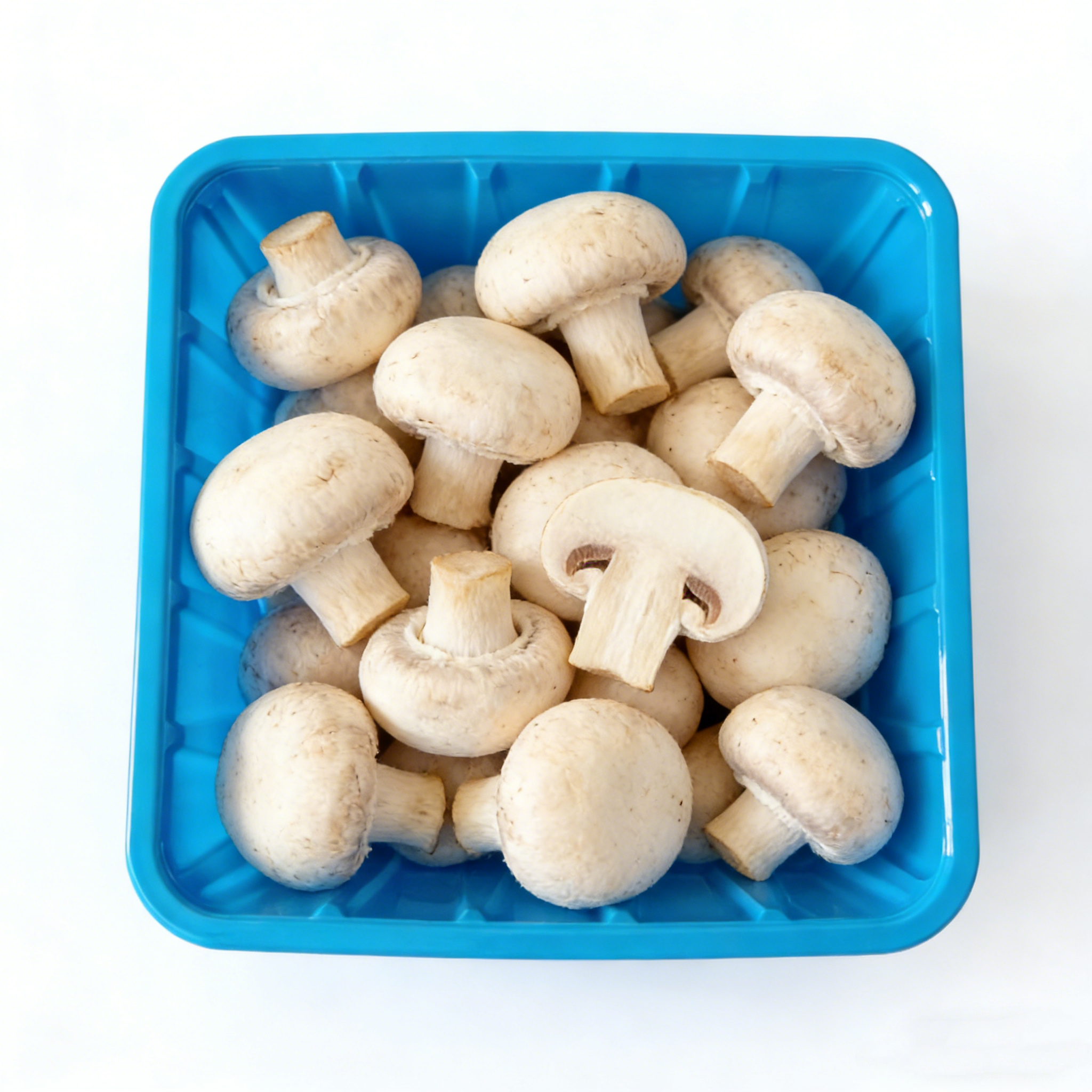
Why a Single Certificate Pack Rarely Answers Every Market
Food-contact compliance is not one document. It is a stack of documents, and the stack is filtered by destination. The same tray can be sold into a market where a supplier self-declaration is accepted alongside migration testing, and into a market where the retailer’s technical team wants an item-level model list, a declared intended-use statement and batch traceability before it will list the SKU.
Three practical consequences follow, and they define how a buyer should read any dossier:
- The claim and the evidence are separate objects. “Meets food contact safety standards” is a claim. A test report naming the standard, the sample and the issue date is evidence. The two must be linked by model number, or the claim is unverifiable.
- A wide market scope is not the same as market-specific approval. A certificate whose scope field reads NA / EU / ME / SEA / LATAM tells you where the supplier intends the document to be usable. It does not tell you what a specific national authority or a specific retailer will demand on top.
- Validity windows are part of the specification. Certificates expire. A dossier assembled in one quarter may be incomplete in the next, and buyers who do not check remaining validity inherit the problem.
The corrective action is procedural rather than technical: map each destination market to the specific documents it asks for, then hold that mapping inside the purchasing terms and acceptance criteria before the order is confirmed.
How the Compliance Question Is Changing: Industry Background
The scale of the category explains why documentation discipline is tightening. Independent market research places the global fresh food packaging market at USD 134.60 billion in 2024, projected to reach USD 240.50 billion by 2035 (Spherical Insights & Consulting). The narrower produce packaging segment — fruit and vegetables specifically — was valued at approximately USD 38.08 billion in 2024 (Market Research Future). Europe alone accounted for USD 15.2 billion in 2024, with a projected CAGR of 4.5% through 2033. Thermoformed plastics for food packaging are expected to grow at a CAGR of 4.9%, reaching USD 20.66 billion by 2030 (Grand View Research).
Two regulatory signals sit on top of that volume:
- EU Regulation (EC) No 1935/2004 provides the framework for all food contact materials, requiring that they do not release constituents into food at levels harmful to human health.
- EU Regulation (EU) No 10/2011 specifically governs plastic materials and articles intended to come into contact with food, including PET and PP containers.
- PPWR: starting from 2030, the EU Packaging and Packaging Waste Regulation will ban single-use plastic packaging for fresh fruit and vegetables under 1.5 kg.
The first two shape what a declaration must contain today. The third shapes what buyers are already writing into forward specifications — recyclability, material reduction and packaging-design justification are moving from a marketing topic into a purchasing section. For PET produce tray buyers in the Research-to-Evaluation stage, the practical effect is that the compliance conversation no longer closes at “is it food grade?”; it now extends to how the material, the model and the intended use are documented and to whom.
The Declaration Layer: What “PET, BPA-Free, Food-Contact Safe” Has to Actually Say
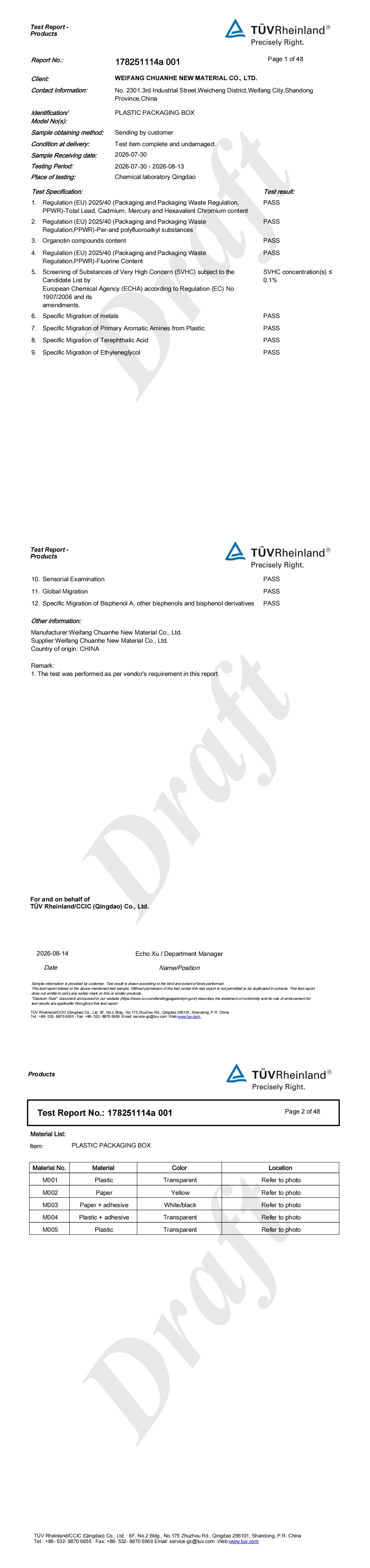
A declaration becomes auditable when it breaks into named parameters with a named test behind each. In a real PPWR-aligned test report issued by TÜV Rheinland (reference 178251114a 001, covering plastic packaging, issued 14 August 2026, valid to 14 August 2030), the scope is not a single pass/fail line. It enumerates:
- Total Lead, Cadmium, Mercury and Hexavalent Chromium content
- Per- and polyfluoroalkyl substances (PFAS) under Regulation (EU) 2025/40 (PPWR)
- Organotin compounds content
- Fluorine content
- Screening of Substances of Very High Concern (SVHC) subject to the ECHA Candidate List under Regulation (EC) No 1907/2006
- Specific migration of metals
- Specific migration of primary aromatic amines (PAA) from plastic
- Specific migration of terephthalic acid
- Specific migration of ethylene glycol
- Global migration
- Sensorial examination
- Specific migration of Bisphenol A, other bisphenols and bisphenol derivatives
The BPA line is the one that converts a marketing phrase into evidence. “BPA-free” is only meaningful if it is attached to a bisphenol migration test with a reference number and a date. For PET produce trays, terephthalic acid and ethylene glycol migration matter for the same reason: they are the monomer residues a reviewer expects to see addressed on a PET container, and their absence from a dossier is a gap, not a reassurance.
Market-by-Market: Mapping Each Destination to Its Own Document Set
The working principle is simple: do not reuse one certificate pack; map each market’s questions to specific documents. Below is how that mapping reads for a PET produce tray programme.
European Union
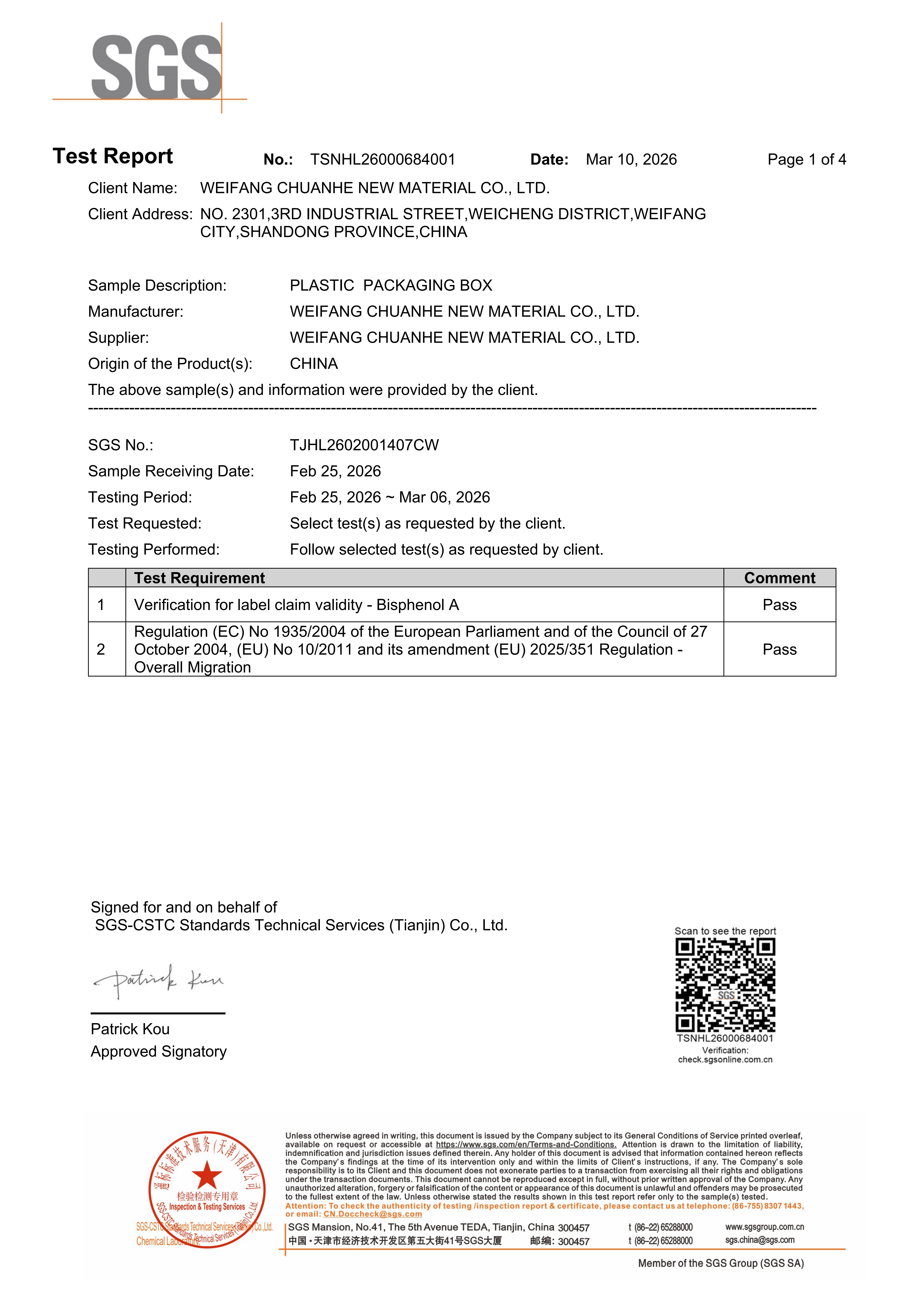
The EU question is usually framed around Regulations (EC) No 1935/2004 and (EU) No 10/2011, with PPWR now entering the specification. In the worked dossier, the EU-relevant evidence includes a CE certificate for the fruit & vegetable container HB-7001 (certificate number M.2025.206.C131101, issued by UDEM, standard EN 1186-1:2002, valid to 12 November 2030), an SGS EU certificate (number TSNHL26000684001, standard EN 1186-3:2022, issued 10 March 2026, valid to 10 March 2036), and the PPWR test report described above. The BRCGS certificate (number CN26/00005423, Global Standard for Packaging Materials, issued by SGS, valid to 3 August 2027) is typically the document a European retailer’s technical team recognises fastest, because it speaks in the language of packaging-material management systems rather than product chemistry alone.
North America (United States and Canada)
The US question is framed around FDA food-contact expectations. The worked dossier carries two complementary items: an FDA certificate (number 11242824478, issued by CNQI, standard P.L. 107-188, issued 5 March 2025, valid to 31 December 2026) and an SGS-issued certificate tested to US FDA 21 CFR 177.1630 (number TSNHL26001599701, issued 22 April 2026, valid to 22 April 2036). Note the asymmetry: the second document’s validity runs a decade beyond the first. A buyer assembling a pack in late 2026 should confirm which of the two the receiving importer treats as controlling, and should expect to reconfirm the shorter-dated item before the next order cycle.
Middle East, Southeast Asia and LATAM
These destinations sit inside the declared market scope of the same certificate set — the PPWR report, the SGS EU and FDA-testing certificates, and the BRCGS certificate all list NA / EU / ME / SEA / LATAM. What differs is the receiving-side filter: an importer, a customs broker or a retail technical team in these markets may ask for the same underlying tests but in a different order, with a different labelling emphasis, or with traceability extended to batch and shipment level. The production evidence that supports those requests comes from delivered programmes rather than from the certificate alone: the Middle East fruit and vegetable programme running at a monthly order of approximately 250,000 pieces over more than three years, and the Southeast Asia programme at approximately 500,000 pieces per month over more than twelve years.
Model-Level Evidence: Tying the Claim to the Actual SKU
Compliance statements are usually written at category level (“PET, food grade, BPA-free”) while purchase orders are placed at model level. The bridge between the two is an item-level model list with declared dimensions and material. Without it, a buyer cannot prove that the tray arriving in container 3 is the tray the migration test referenced.
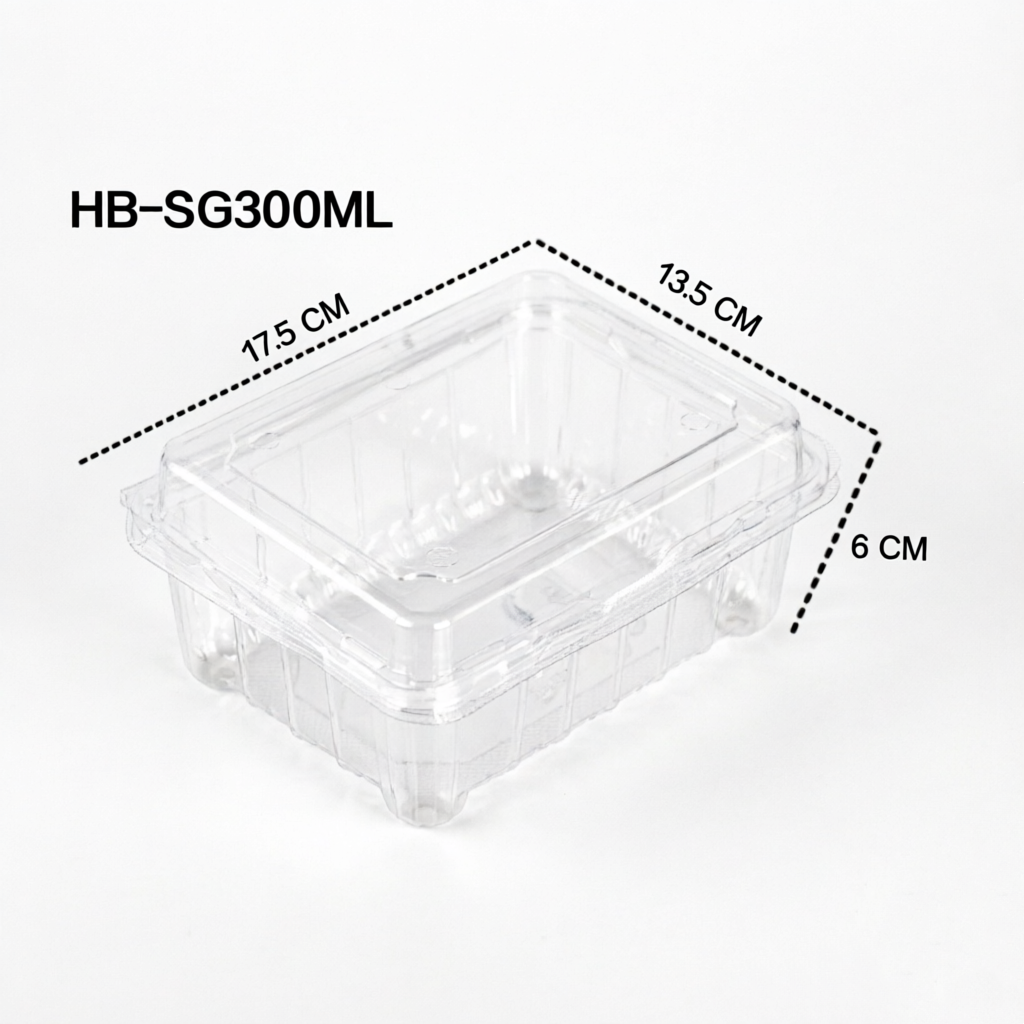
Three models are worth naming because they illustrate different documentation demands. HB-MG08 OZ measures 14.2 × 12.5 × 6.8 cm and belongs to the tray series described as compatible with MAP modified-atmosphere packaging production lines, with intended uses spanning produce, bakery, meat, poultry and ready meals. HB-SG300ML measures 17.5 × 13.5 × 6 cm and sits in the fruit & vegetable container series, where the specification covers refrigerator safety, food-grade BPA-free plastic and stackability. HB-3066 measures 14.4 × 12.2 × 4.7 cm, a shallower tray in the same tray family.
All three are PET. All three sit inside the declared market scope of the certificate set. None of them should be presented to a buyer as “covered” without the supplier confirming which document line actually names that model — and that confirmation should be written into the dossier, not carried verbally.
Intended Use and End-User Profile: Why the Same Tray Needs Different Wording
Intended use is the second-most-common gap in a compliance dossier after model linkage. It matters because the same PET tray can be specified for produce, bakery, MAP, meat and chilled ready meals — five different use contexts with different reviewers.
In the worked corpus, the tray series is described as food grade BPA-free plastic compliant with food contact safety standards, rigid and anti-deformation to reduce goods damage in transit, chemically compatible with MAP modified-atmosphere packaging production lines, available in multiple sizes for produce, bakery, meat, poultry and ready meals, and stackable to save warehouse and retail display space. The fruit & vegetable container series is described as refrigerator safe, food grade BPA-free, stackable and clear for retail display. The salad container series adds a leakproof, airtight lid and an optional compartment design that separates sauce from vegetables.
The end-user profile similarly changes the burden. The documented applicable industries are produce wholesalers, supermarket chains, agricultural exporters, bakeries and food retailers, and e-commerce brands seeking custom packaging. A supermarket chain will press hardest on display clarity and lid integrity. An agricultural exporter will press on transit damage and batch consistency. An e-commerce fresh brand will press on leak resistance and stackability in mixed cartons. None of these buyers needs a different tray — they need the same tray documented against a different intended-use sentence.
Step-by-Step: Building a Market-Specific Compliance Dossier
- Fix the destination list before the model list. Write down every market the SKU will actually be sold into, plus any market the retailer may transship to. Compliance scope follows the destination list, not the supplier’s full catalogue.
- Fix the model list. Name each model precisely — HB-MG08 OZ, HB-SG300ML, HB-3066 and so on — with declared dimensions and material. Vague entries like “8 oz tray” cannot be reconciled to a test report.
- Map declaration type per market. For each destination, record which document is controlling: a self-declaration, a migration test report, a framework certificate, or a packaging-material management certificate such as BRCGS.
- Collect item-level evidence, not category-level evidence. Ask the supplier to state, in writing, which document line covers each requested model.
- Check validity windows on every document. Record issue and expiry dates as fields in the dossier. In the worked set, validity ranges from 31 December 2026 on the FDA certificate (11242824478) to 2036 on the SGS-issued tests.
- Lock the compliance scope into purchasing terms and acceptance criteria. This is the checkpoint. Specify which documents accompany the shipment, which models they must name, whether batch or lot traceability is required, and what constitutes rejection at acceptance.
- Validate by sample before order confirmation. A physical sample confirms wall rigidity, lid closure, stack behaviour and clarity. Documentation confirms the legal claim; the sample confirms that the documented article is the article you will receive.
- Re-verify at renewal. Diary the earliest expiry date in the pack and treat it as a recurring purchasing event rather than a one-off onboarding task.
Use Cases: How Different Buyer Types Read the Same Dossier
European supermarket chain
A European retail programme spanning the UK, Germany, France, Italy, Spain, Finland, the Netherlands and Portugal, running at approximately 350,000 pieces per month over more than seven years, reports stable quality, high delivery reliability and a reduced customer complaint rate, with documented compliance to EU standards, food-grade material, stackable design and custom printing support. For this buyer type, the controlling documents are the EU-framework items plus BRCGS, and the acceptance criteria normally name the model, the print specification and the lid performance.
United States importer and food retail distributor
A US programme at approximately 120,000 pieces per month over more than three years covers fresh fruit and ready-meal packaging for supermarket retail, qualified for FDA food contact standard, with stable supply and on-time delivery, custom size and PET material, microwave-safe performance and customised printing. Here the controlling document is the FDA-line evidence, and the buyer’s question is usually about the SKU-to-certificate link rather than the chemistry.
LATAM agricultural exporter
A programme across Chile, Argentina, Brazil, Colombia and Peru, at approximately 250,000 pieces per month over more than six years, covers fresh fruit and vegetable packaging, food-factory processing, retail display and wholesale distribution, with food-grade material, stackable design, high transparency and customisable size, logo and colour. Exporters in this position typically need the product documents plus customs-clearance documentation assistance, which is a service item rather than a product claim.
Middle East and Southeast Asia programmes
The Middle East fruit and vegetable programme (approximately 250,000 pieces per month, more than three years) covers farm-fresh produce, cherry tomato and berry clamshell packaging, harvest sorting and retail display, with vent holes for freshness positioned as central to the specification. The Southeast Asia programme (approximately 500,000 pieces per month, more than twelve years) adds cold-chain suitability for seafood and meat alongside produce.

Comparison Tables
The first table maps models to declared material, dimensions and typical use, so that a buyer can reconcile the purchase order line against the dossier. All entries below are drawn from the supplier’s declared product data.
| Model | Series | Material | Dimensions (cm) | Typical fit |
|---|---|---|---|---|
| HB-MG08 OZ | Produce tray | PET | 14.2 × 12.5 × 6.8 | Small produce portions; bakery; MAP-line compatible |
| HB-MG24 OZ | Produce tray | PET | 18.6 × 18.6 × 8.9 | Larger produce; meat; chilled ready meals |
| HB-MG40 OZ | Produce tray | PET | 28 × 19.4 × 6.8 | Bulk and display trays |
| HB-3066 | Produce tray | PET | 14.4 × 12.2 × 4.7 | Shallow portions; retail display |
| HB-7001 | Fruit & vegetable container | PET | 19.5 × 19.5 × 5 | Refrigerator storage; supermarket display |
| HB-SG300ML | Fruit & vegetable container | PET | 17.5 × 13.5 × 6 | Fresh vegetable storage; display |
| HB-SG1000ML | Fruit & vegetable container | PET | 23 × 17.5 × 9 | Higher-volume produce packing |
| HB5053 | Salad container | PET | 15.2 × 10.2 × 5.3 | Salad and prepared food; leakproof lid |
| HB1720 | Salad container | PET | 18.5 × 18.5 × 6 | Salad bowls; optional compartment |
| HB-32 OZ | Tamper evident | PET | 17.2 × 15.5 × 6.2 | Retail tamper-evident packs |
| HB-16OZ | Tamper evident | PET | 14 × 11.6 × 6.2 | Retail tamper-evident packs |
The second table lists the certificate and test documents in the worked dossier, with issuing body, reference number, declared market scope, applicable standard and validity. Buyers can use the same column structure for their own dossier, so that expiry dates become visible at a glance.
| Document | Issuing body | Reference no. | Declared market scope | Applicable standard / scope | Issued | Valid to |
|---|---|---|---|---|---|---|
| CE | UDEM | M.2025.206.C131101 | EU | EN 1186-1:2002 | 2025-12-12 | 2030-11-12 |
| SGS (EU) | SGS | TSNHL26000684001 | NA / EU / ME / SEA / LATAM | EN 1186-3:2022 | 2026-03-10 | 2036-03-10 |
| SGS (FDA testing) | SGS | TSNHL26001599701 | NA / EU / ME / SEA / LATAM | US FDA 21 CFR 177.1630 | 2026-04-22 | 2036-04-22 |
| FDA | CNQI | 11242824478 | NA / EU / ME / SEA / LATAM | P.L. 107-188 | 2025-03-05 | 2026-12-31 |
| BRCGS | SGS | CN26/00005423 | NA / EU / ME / SEA / LATAM | Global Standard for Packaging Materials | 2026-07-08 | 2027-08-03 |
| PPWR product test report | TÜV Rheinland | 178251114a 001 | NA / EU / ME / SEA / LATAM | Regulation (EU) 2025/40 (PPWR) | 2026-08-14 | 2030-08-14 |
Manufacturing Capability Behind the Documents
Documentation is credible in proportion to the production system that generates it. CHUAN HE operates from a 62,000 m² base in Weifang, Shandong, adjacent to Qingdao Port, with 20 fully automatic thermoforming machines and 20 standard thermoforming machines, including four Kiefel machines imported from Germany, supported by four PET sheet extrusion lines, two PP sheet extrusion lines and an in-house mould workshop. The company was founded in 2013, runs an annual output of 54,000 tonnes with a monthly capacity of 4,500 tonnes, applies 100% testing as its quality-control regime, and holds CE, BRC, FDA, EU and SGS management-system certifications. Customisation covers logo, size and colour with ODM/OEM support; standard lead time is 30–45 days and the minimum order quantity is 10,000 pieces. After-sales support includes order and shipment tracking, customs-clearance documentation assistance, technical consultation on product parameters, resolution routes for quality or damaged-goods issues, packaging and shipping optimisation, and ongoing support for customised design.
FAQ
When evaluating EU food contact certified fresh produce packaging manufacturers, what should I actually check?
Check three things in sequence. First, the standard named on the document: for EU-relevant plastic packaging this includes EN 1186-1:2002 and EN 1186-3:2022 test standards, within the framework of Regulation (EC) No 1935/2004 and Regulation (EU) No 10/2011 for plastic materials in contact with food. Second, the market scope field — a certificate may declare NA / EU / ME / SEA / LATAM, which is a scope statement rather than a national approval. Third, the issuing body and reference number, so the document is traceable: for example, a CE certificate issued by UDEM under number M.2025.206.C131101 for the HB-7001 fruit & vegetable container, or an SGS EU certificate under number TSNHL26000684001. A manufacturer who can present the standard, the scope and the reference together is giving you an auditable document rather than a claim.
How do I confirm that a food-contact claim covers my exact model and not just the category?
Ask for an item-level model list that states, for each model you buy, which document line covers it. Category statements such as “PET, food grade, BPA-free” apply to a series; a purchase order applies to a model with dimensions. For example, HB-MG08 OZ is declared at 14.2 × 12.5 × 6.8 cm, HB-SG300ML at 17.5 × 13.5 × 6 cm and HB-3066 at 14.4 × 12.2 × 4.7 cm — three different articles within the same PET family. If the supplier cannot name the model on the document, the claim is not yet linked to your order line.
Do I need a different document set for each destination market?
You need a different mapping, not necessarily a different certificate. One certificate set can declare a broad market scope while each destination asks its own questions. In the worked dossier, the FDA-line evidence (FDA certificate 11242824478, valid to 31 December 2026, and the SGS-issued certificate TSNHL26001599701 tested to US FDA 21 CFR 177.1630, valid to 22 April 2036) answers the North American question, while the EN 1186 series certificates and the PPWR test report answer the European question. Note also that validity windows differ sharply across the set, so the mapping must be reviewed, not filed.
Where should compliance scope, samples and documentation requirements be locked?
In the purchasing terms and acceptance criteria, before order confirmation. That is the point where the buyer should state which documents accompany the shipment, which models those documents must name, whether batch or lot traceability is required, and what constitutes rejection at acceptance. Locking this later — after production or at the importer’s desk — converts a documentation question into a delivery dispute, and the cost of delay is carried by the buyer.
Can I validate the tray physically before committing to a full order?
Yes, and it is the recommended sequence. Standard lead time is 30–45 days and the minimum order quantity is 10,000 pieces, so a physical sample confirms wall rigidity, lid closure, stack behaviour and clarity before an order is placed, while the documentation confirms the legal claim. Combining both — a sample plus a model-linked dossier — is the only way to be sure that the documented article is the article you will receive. To request a sample, a quotation or the current product catalogue, contact the CHUAN HE team at newplasticbox.com or email chuanhe@newplasticbox.com.
Conclusion
Regional food-contact compliance for PET produce trays is a mapping exercise, not a single certificate. The material claim — PET, food grade, BPA-free — stays constant across destinations; the evidence behind it is filtered differently by each market, and the filter operates at three levels: the standard named on the document, the market scope field, and the item-level model list that ties the document to the SKU on the purchase order.
Buyers who get this right do three things consistently. They fix the destination list before the model list. They record issue and expiry dates as dossier fields rather than filing documents away, because the certificate set in this guide ranges from a 2026 expiry on the FDA line to 2036 on the SGS-issued tests. And they write the compliance scope, the sample requirement and the documentation list into the purchasing terms and acceptance criteria before confirming the order — the single checkpoint where an ambiguous claim becomes a specified one.
Request the compliance dossier, samples and catalogue
CHUAN HE supplies PET and PP thermoformed containers and trays for fruit and vegetable packaging, salad containers and tamper-evident packs, with ODM/OEM customisation on logo, size and colour. Standard lead time is 30–45 days, MOQ 10,000 pieces, and 100% testing across production.
Download the product catalogue: CHUAN HE 2026 packaging catalogue (PDF)
Request a sample or quotation: www.newplasticbox.com | chuanhe@newplasticbox.com | +86 134-5566-2777
Weifang Chuanhe New Material Co., Ltd. — No. 2301 Industrial Third Street, Weicheng Economic Development Zone, Weifang City, Shandong Province, China.
Have Questions or Need More Details?
Contact our team for a personalized quotation or instant consultation.
Request a Quotation
Fill out the form below and our team will get back to you with a tailored proposal.
WhatsApp Direct Chat
Prefer to chat in real-time? Message us on WhatsApp for instant assistance & quick answers.
- Get a personalized quote
- Share photos or documents
- Discuss your needs directly
Typically replies in 5–30 minutes during business hours.