
Fruit & Vegetable Packaging Basics: Containers, Trays, Salad Boxes, and Tamper Evident Formats
Fruit & Vegetable Packaging Basics: Containers, Trays, Salad Boxes, and Tamper Evident Formats
Fruit and vegetable packaging is the rigid plastic system that carries fresh produce from the packhouse to the retail shelf. In current catalogues it is organised into four format families: fruit and vegetable containers, trays, salad containers, and tamper evident packaging. They share one material base — thermoformed PET, food grade and BPA-free, compliant with food contact safety standards — but they are built around different opening behaviour, stacking patterns and retail jobs.

That distinction matters early. A buyer in the research stage is usually not yet choosing between suppliers — they are working out which format family their product actually belongs to, and what a normal specification inside that family contains. Getting the format wrong is expensive in a quiet way. It surfaces later as crushed fruit, condensation on the lid, damaged corners in transit, or a closure that store staff cannot tell has been opened.
This guide maps the four categories against the catalogue language used to describe them, the published model dimensions, and the material facts that apply across all of them. Model references come from the CHUAN HE catalogue so that every format family is anchored to something concrete rather than to an abstract description.
Why this category is harder to specify than it looks
Four difficulties repeat in almost every first fresh-produce packaging brief, and understanding them early prevents most specification errors.
- Format names overlap. A hinged container, a clamshell and a punnet can all describe the same object, while a tray and a container can describe objects with completely different sealing behaviour. Two suppliers quoting on the word container may be quoting two different products.
- Volume labels are trade names, not measurements. Sizes quoted in ounces are commercial designations. One US fluid ounce equals 29.5735295625 millilitres, which puts 8 oz at approximately 236.6 ml, 16 oz at approximately 473.2 ml, 20 oz at approximately 591.5 ml, 24 oz at approximately 709.8 ml and 32 oz at approximately 946.4 ml, but nominal trade sizes may not equal exact conversions and should be verified against the manufacturer datasheet.
- Same resin, different structure. Material alone tells you very little. A shallow tray and a deep container can both be PET and still behave completely differently under top load, in a cold chain, and on a supermarket shelf.
- Compliance is a document set, not a product feature. Food contact status is evidenced by declarations and test support, not by the appearance of the pack.
Industry background: what is shaping the category in 2026
The category is large, PET-weighted and increasingly regulated, which is why format decisions made today tend to have a multi-year tail.
One commercial research estimate places the global produce packaging market at USD 38.08 billion in 2024 and projects USD 59.87 billion by 2035. The same research source reports PET as the dominant clamshell material with a 42 percent share in 2026, while polypropylene is described as the fastest-growing material on heat-resistance grounds. These figures come from commercial market research rather than from government statistics, so they are useful for directional framing rather than for procurement planning.
Regulation is the stronger force. In the European Union, Regulation (EC) No 1935/2004 Article 3 sets the framework obligation: materials must not transfer constituents to food in quantities that could endanger human health, change food composition unacceptably, or deteriorate organoleptic characteristics. Regulation (EU) No 10/2011 adds the plastic-specific layer, including an overall migration limit of 10 milligrams of constituents per square decimetre of food contact surface, a Union list of authorised substances, and a written declaration of compliance requirement at marketing stages other than retail. The Packaging and Packaging Waste Regulation (EU) 2025/40 entered into force on 11 February 2025 and applies from 12 August 2026, with an all-packaging recyclability obligation from 1 January 2030 and a 30 percent minimum recycled content requirement for contact-sensitive PET packaging from the same date. Expanded polystyrene food containers have already been restricted under the Single-Use Plastics Directive since 3 July 2021.
In the United States the route is different but equally documented: polyethylene phthalate polymers, the family that includes PET, are permitted for food-contact articles under 21 CFR 177.1630, and olefin polymers including polypropylene under 21 CFR 177.1520. At supply-chain level, the GS1 Fresh Fruit and Vegetable Traceability Guideline covers coding and label fields, and ISO 22000:2018 sets food safety management system requirements that packaging manufacturers are commonly audited against.
Technology direction is also moving. A 2025 peer-reviewed review in Foods concludes that smart packaging is a promising solution for improving fruit and vegetable quality during preservation — a directional signal that functional features, not just structural ones, will keep entering format specifications.
The four format families, defined
The material base they share
Across all four families, the CHUAN HE catalogue describes PET construction, food grade BPA-free plastic compliant with food contact safety standards, clear transparent bodies, stackable design, and customisation of size, colour and logo. That shared base is what makes format comparison possible: you are not comparing materials, you are comparing geometry, closure and function.
Two clarifications are worth stating plainly. First, PET and PP are not interchangeable compliance routes — the EU positive list and the US indirect additive listings treat them under separate provisions, and conformity under one jurisdiction does not imply conformity under another. Second, recyclability and recycled content are now dated obligations rather than marketing positions, so a format chosen today should be checked against the 2030 design and content targets if the pack will still be on shelf then.
1. Fruit & Vegetable Containers
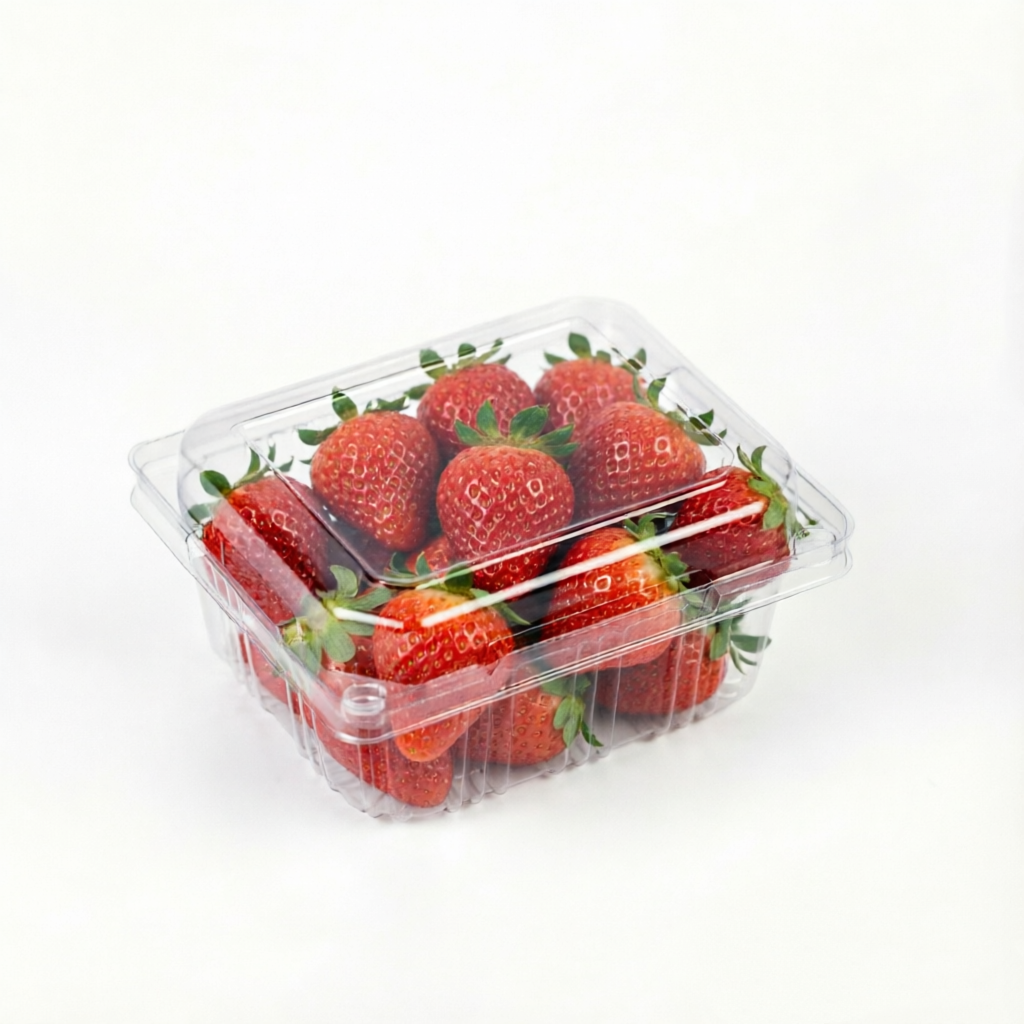
Fruit and vegetable containers are small to medium lidded boxes used for berries, small fruit, and refrigerator storage of fresh produce. In the CHUAN HE range, the Fruit & Vegetable Container family is built in PET and states refrigerator-safe use, food grade BPA-free construction, stackable design, and a clear transparent body suited to retail display.
Two catalogued models anchor the family. HB-SG250ML measures 13.5 × 11.5 × 6.5 cm. HB-8OZ-235 measures 14.3 × 12.5 × 6 cm. The same product family is catalogued with additional references including HB-7001, HB-SG300ML and HB-SG1000ML, which extends the family across a wider size spread than the two anchor models alone suggest.
The functional logic here is containment plus visibility. A berry pack has to hold fruit without crushing it, stay legible on a chilled shelf, and allow the shopper to inspect the fruit without opening the pack. Stackability is not a warehouse detail; it is what allows a display to be built quickly and a backroom to stay organised.
2. Trays Packaging
Trays are the shallow, open-format member of the family. The CHUAN HE Trays Packaging range is built in PET and states a rigid sturdy structure that resists deformation and reduces goods damage in transit, compatibility with MAP modified atmosphere packaging production lines, stackable design, clear transparency, and custom shape, colour, embossing and logo printing.
Four catalogued models show the size range clearly. HB-T9333 measures 16.8 × 11.4 × 3 cm. HB-T9576 measures 19.4 × 11.4 × 5.8 cm. HB-MG08 OZ measures 14.2 × 12.5 × 6.8 cm. HB-MG24 OZ measures 18.6 × 18.6 × 8.9 cm. Between them, the four references cover a shallow display tray, a longer rectangular tray, and two deeper formats.
The differentiator is not the resin; it is the lidding route. A tray is designed to be closed by a film or lid on a separate line, which is why MAP compatibility appears as a stated property. If a buyer intends to run modified atmosphere packing, the tray decision and the line decision are effectively one decision.

3. Salad Containers
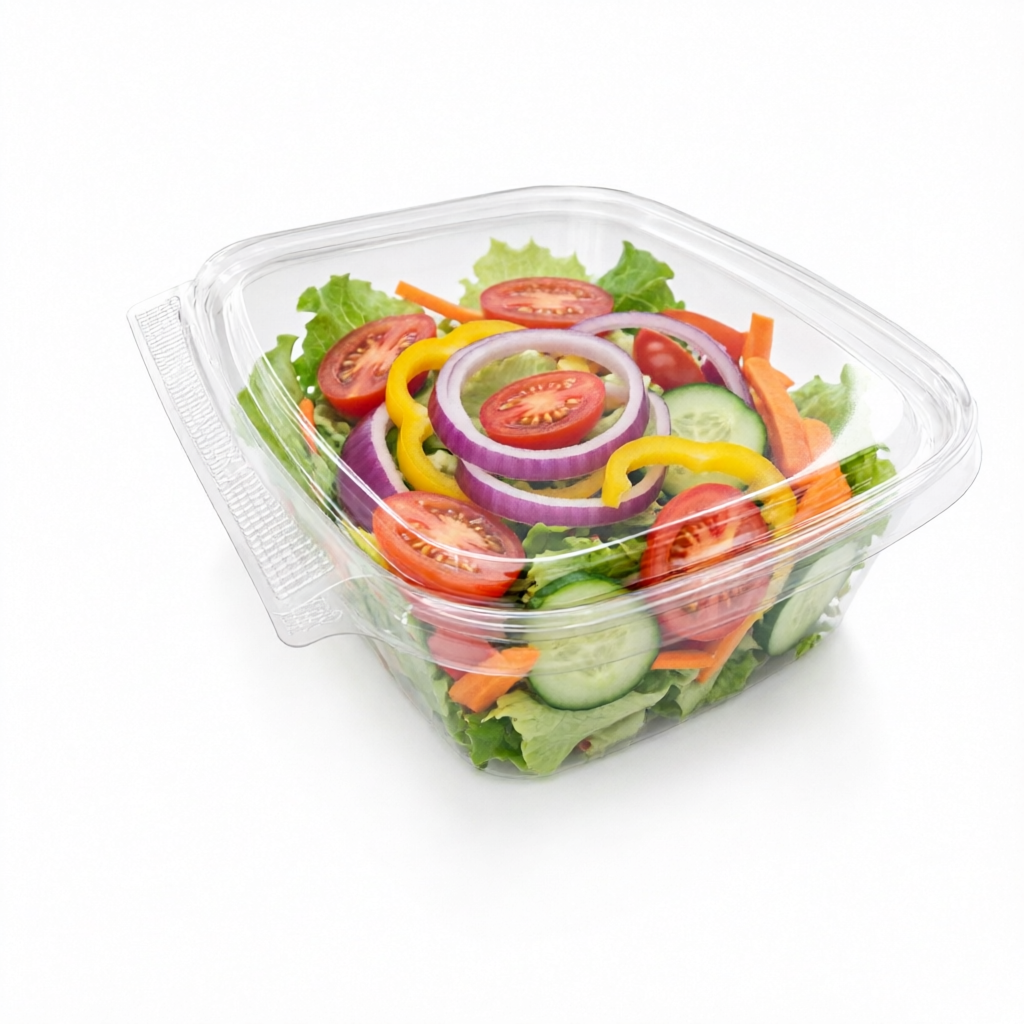
Salad containers are the leak-conscious member of the family. The CHUAN HE Salad Container range is built in PET and states food grade BPA-free plastic safe for direct contact with salads, fruits and prepared food, a leakproof and airtight lid that prevents dressing spillage during delivery, an optional compartment design that separates sauce from vegetables, a stackable structure, durable anti-break material, and clear transparency for retail display.
The anchor model is HB1720, measuring 18.5 × 18.5 × 6 cm. Its square footprint is the practical clue: salad boxes are usually specified around a portion format and a delivery route, not around a produce item. The lid seal is the specification, because a salad that leaks in a delivery bag is a return, not a sale.
This is also the format where compartment design changes the product rather than the packaging. Separating dressing from leaves keeps texture intact, and that is a product-quality function performed by the container.
4. Tamper Evident Packaging
Tamper evident packaging is the closure-integrity member of the family. The CHUAN HE Tamper Evident range is built in PET and catalogued for fruit and vegetable packs, salads, cakes, sweets and bakery containers. Stated properties include high transparency, availability in rectangle, square, round and customised shapes, personalised colours and sizes, and ODM/OEM support.
The series runs from HB-8OZ through HB-16 OZ, HB-20 OZ, HB-24 OZ and HB-32 OZ. Published dimensions are 14 × 11.6 × 6.2 cm for HB-16 OZ, 14 × 11.6 × 7.9 cm for HB-20 OZ, and 17.2 × 15.5 × 6.2 cm for HB-32 OZ.
The purpose of the format is evident at the shelf. Where a standard container asks the shopper to trust that the pack is intact, a tamper evident format is designed so that interference is visible. That matters most in high-turnover categories where the same pack may be handled repeatedly before purchase, and in prepared-food categories where contents are not washed before eating.
A step-by-step format selection sequence
The sequence below is designed for a first-pass decision that can be defended in an internal review, not for final supplier selection.
Step 1 — Define the product and its handling path
Start with the item, not the pack. Berries, cherry tomatoes, mushrooms, cut salad and dry fruit have different crush sensitivity, moisture behaviour and expected shelf time. The handling path — field to packhouse to distribution centre to store — determines how much structural protection the format has to supply.
Step 2 — Decide whether closure integrity is a requirement
If the pack must show evidence of opening, the decision is made: specify from the tamper evident series. If the pack is a display or storage container that staff may open and reclose, a standard container is the simpler answer.
Step 3 — Decide whether the pack will be sealed on a MAP line
Modified atmosphere packing requires a tray format and a sealing line. Where MAP is planned, the tray family is the starting point and MAP line compatibility becomes a hard requirement rather than a preference.
Step 4 — Decide whether liquid separation is part of the product
Dressings, sauces and marinades push the decision towards the salad container range, where a leakproof and airtight lid and an optional compartment are stated properties.
Step 5 — Normalise every quoted size before comparing
Convert ounce designations to millilitres and confirm actual fill volume per datasheet. A 16 oz quote and a 470 ml quote may describe the same object, or two objects a few millimetres apart in every dimension.
Step 6 — Assemble the food contact document set
For EU-bound packs, the working document set is the framework safety obligation, the plastic-specific declaration of compliance, evidence supporting the Union list and migration position, and traceability records. For US-bound packs, the corresponding indirect additive listings apply. Ask for the documents before asking for the price; a pack without a document set is not a candidate.
Step 7 — Check stackability and secondary packing
Stackable design is stated across all four families, but the geometry differs. Confirm the stacked height, the pallet pattern, and whether the display build in store depends on the pack stacking directly or sitting in a secondary tray.
Step 8 — Specify customisation last
Shape, colour, embossing and logo printing are available across the container, tray and tamper evident ranges, and ODM/OEM support is stated for the tamper evident series. Customisation is best fixed after format and dimension are settled, because a custom shape cannot rescue a wrong format.
Where the manufacturer fits into the picture
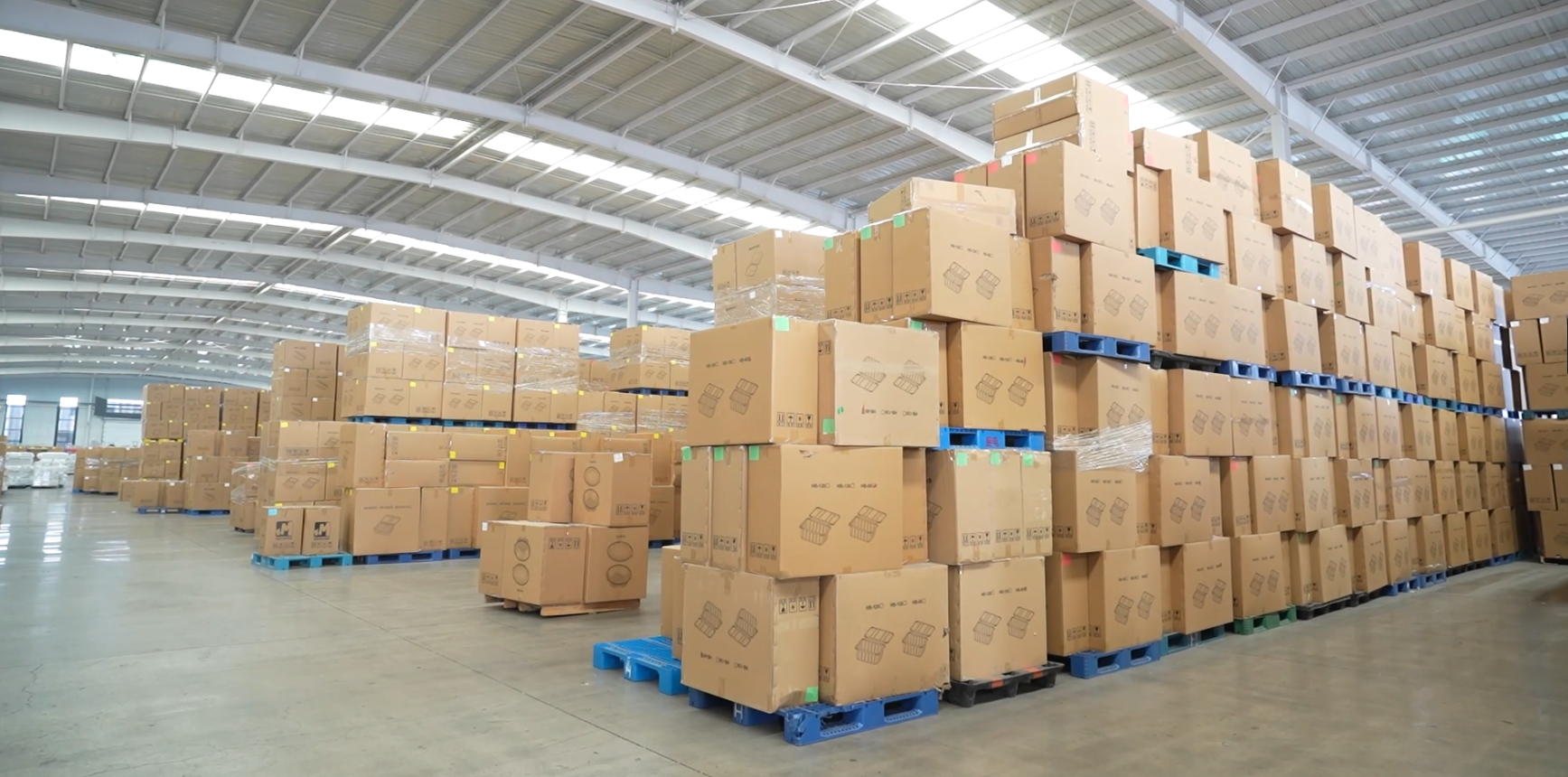
Weifang Chuanhe New Material Co., Ltd. (CHUAN HE) is a China-based manufacturer of PET and PP thermoformed packaging, founded in 2013 and operating from a 62,000 m² facility in Weifang, Shandong, adjacent to Qingdao Port. The company reports a 100 percent export ratio and markets across the EU, US, Latin America and the Middle East, and states CE, BRC, FDA, EU and SGS certification.
From a format-selection standpoint, the relevant capability facts are the tooling and sheet position: 20 fully automatic thermoforming machines including 4 Kiefel machines imported from Germany, plus 20 standard thermoforming machines, 4 PET sheet extrusion lines and 2 PP sheet extrusion lines, alongside an in-house mould workshop. In-house sheet extrusion is what allows a buyer to discuss material grade and recycled content as a production input rather than as a purchased add-on.

Which format fits which fresh item
Matching format to item is the fastest way to cut a long list down to two or three candidates.
- Strawberries and soft berries. Small lidded containers — HB-SG250ML at 13.5 × 11.5 × 6.5 cm and HB-8OZ-235 at 14.3 × 12.5 × 6 cm — with clear bodies for inspection and stackable geometry for display builds.
- Cherry tomatoes and small snacking fruit. Tamper evident formats in the HB-16 OZ to HB-32 OZ band, where closure integrity supports self-service handling.
- Mushrooms and loose produce. Shallow trays such as HB-T9333 at 16.8 × 11.4 × 3 cm, or deeper formats such as HB-MG08 OZ at 14.2 × 12.5 × 6.8 cm where fill weight is higher.
- Prepared salads and cut fruit. HB1720 at 18.5 × 18.5 × 6 cm, specified around the leakproof and airtight lid and the optional compartment.
- Bakery, sweets and confectionery cross-merchandising. The tamper evident range is catalogued for cakes, sweets and bakery items as well as produce, which allows a retailer to standardise on one closure logic across adjacent categories.
- Refrigerator and back-of-house storage. The Fruit & Vegetable Container family states refrigerator-safe use, which makes it usable as a storage format as well as a retail pack.
Format comparison at a glance
The table below uses only catalogued model references, stated dimensions and stated properties. It is a starting map, not a substitute for a datasheet.
| Format | Catalogued models | Stated outer dimensions | Material | Stated structural traits | Typical fresh-produce fit |
|---|---|---|---|---|---|
| Fruit & Vegetable Container | HB-SG250ML; HB-8OZ-235; family references include HB-7001, HB-SG300ML, HB-SG1000ML | 13.5 × 11.5 × 6.5 cm; 14.3 × 12.5 × 6 cm | PET | Refrigerator safe; food grade BPA-free; stackable; clear transparent body; custom size, colour and logo | Berries, small fruit, chilled storage and retail display |
| Trays Packaging | HB-T9333; HB-T9576; HB-MG08 OZ; HB-MG24 OZ | 16.8 × 11.4 × 3 cm; 19.4 × 11.4 × 5.8 cm; 14.2 × 12.5 × 6.8 cm; 18.6 × 18.6 × 8.9 cm | PET | Rigid structure resisting deformation; MAP line compatible; stackable; clear transparent; custom shape, colour, embossing and logo | Produce, bakery, meat, poultry and ready meals |
| Salad Container | HB1720 | 18.5 × 18.5 × 6 cm | PET | Leakproof and airtight lid; optional compartment; stackable; anti-break material; clear transparent | Salads, prepared food and cut fruit |
| Tamper Evident Packaging | HB-8OZ; HB-16 OZ; HB-20 OZ; HB-24 OZ; HB-32 OZ | 14 × 11.6 × 6.2 cm (16 OZ); 14 × 11.6 × 7.9 cm (20 OZ); 17.2 × 15.5 × 6.2 cm (32 OZ) | PET | High transparency; rectangle, square, round and customised shapes; personalised colours and sizes; ODM/OEM support | Fruit and vegetable packs, salads, cakes, sweets and bakery items |
Reading notes: ounce designations are trade sizes and should be verified against fill volume per datasheet; the 16 OZ to 32 OZ conversions above are approximate. Dimensions are stated outer dimensions and do not describe internal fill capacity. Compliance status is established by document set, not by format.
Frequently asked questions
What food contact documentation should accompany PET fruit and vegetable packaging?
For the EU market, the framework requirement is Regulation (EC) No 1935/2004 Article 3, which requires that materials do not transfer constituents to food in quantities that could endanger health, unacceptably change food composition, or deteriorate organoleptic characteristics. Plastic articles additionally fall under Regulation (EU) No 10/2011, which sets an overall migration limit of 10 mg per dm² of food contact surface, restricts manufacture to substances on the Union list, and requires a written declaration of compliance at marketing stages other than retail. Traceability at all stages is a separate obligation. For US-bound packs, PET is covered by 21 CFR 177.1630 and olefin polymers such as PP by 21 CFR 177.1520, but the two jurisdictions are not interchangeable and dual-market supply needs both document sets. CHUAN HE states CE, BRC, FDA, EU and SGS certification and describes its products as food grade BPA-free and compliant with food contact safety standards.
Can the formats be customised, and can trays run on a MAP line?
Customisation is stated across the ranges: containers offer custom size, colour and logo printing; trays offer custom shape, colour, embossing and logo printing; tamper evident packs are available in rectangle, square, round and customised shapes with personalised colours and sizes under ODM/OEM support. MAP compatibility is a stated property of the Trays Packaging range, which matters because a tray is closed by film or lid on a separate line rather than by an integral hinge. Buyers planning modified atmosphere packing should confirm tray dimensions against the specific sealing tool rather than assuming compatibility from the format name alone.
How do I compare an 8 oz punnet quote with a millilitre-based quote?
Normalise first. One US fluid ounce equals 29.5735295625 millilitres, so 8 oz is approximately 236.6 ml, 16 oz approximately 473.2 ml, 20 oz approximately 591.5 ml, 24 oz approximately 709.8 ml and 32 oz approximately 946.4 ml. These are conversions of the stated nominal size, not guaranteed fill volumes: nominal ounce designations on packaging are trade names and may not equal exact fluid ounce conversions. The reliable comparison is stated outer dimensions plus verified fill volume from each supplier datasheet, which is also the basis for retail net-content declaration. HB-16 OZ, for example, is published at 14 × 11.6 × 6.2 cm and HB-20 OZ at 14 × 11.6 × 7.9 cm, so the depth difference — not the ounce label — explains the capacity gap.
What should I check on a sample before committing to a format?
Check four things. First, fit: does the item sit in the pack without movement, and does the lid close without forcing? Second, load: stack the sample to the intended display height and confirm the geometry holds. Third, closure integrity if tamper evident: confirm that the opening evidence is visible to store staff without instruction. Fourth, documentation: request the declaration of compliance, traceability records and any management-system certificate such as ISO 22000:2018 alongside the physical sample, so the format and the file are approved together rather than sequentially. CHUAN HE supplies samples and quotation from its Weifang facility and can be reached at chuanhe@newplasticbox.com or through newplasticbox.com.
Summary: choose the format before the specification
Fruit and vegetable packaging resolves into four format families that differ in closure logic rather than in resin. Containers hold and display small fruit and store it cold. Trays present produce and accept a sealed film on a MAP line. Salad containers manage liquid and portion. Tamper evident packs make interference visible. All four are built in PET, food grade and BPA-free, clear, and stackable, and all four are subject to the same food contact obligation that is evidenced by documents rather than by appearance.
The practical sequence for a research-stage buyer is therefore short: identify the item, decide whether closure integrity or liquid separation is a requirement, decide whether the pack runs on a MAP line, normalise the sizes, and only then request samples and prices. The 2030 recyclability and recycled-content milestones are worth noting at the same moment, because a format selected in 2026 will very likely still be in market when those obligations apply.
PETFood grade BPA-freeClear transparentStackableRefrigerator safeMAP line compatible
Need samples or a quotation for a specific format?
CHUAN HE manufactures PET and PP thermoformed fruit and vegetable packaging from a 62,000 m² facility in Weifang, Shandong, with 20 fully automatic thermoforming machines including 4 Kiefel machines, PET and PP sheet extrusion lines, and an in-house mould workshop. Container, tray, salad and tamper evident formats can be quoted with dimensions, material grade and food contact documentation.
Email: chuanhe@newplasticbox.com | WhatsApp: +86 134-5566-2777 | Website: www.newplasticbox.com
Product catalogue and full specification pack: download the CHUAN HE brochure (PDF).
Have Questions or Need More Details?
Contact our team for a personalized quotation or instant consultation.
Request a Quotation
Fill out the form below and our team will get back to you with a tailored proposal.
WhatsApp Direct Chat
Prefer to chat in real-time? Message us on WhatsApp for instant assistance & quick answers.
- Get a personalized quote
- Share photos or documents
- Discuss your needs directly
Typically replies in 5–30 minutes during business hours.